
Key Takeaways:
- Small cracks and surface damage caught early can often be patched affordably — but not all damage qualifies for repair.
- Florida’s heat, humidity, and heavy rainfall accelerate concrete deterioration, making timely patching critical for SWFL driveways.
- Choosing the right patching material and method matters more than most homeowners realize — the wrong approach leads to failed repairs within months.
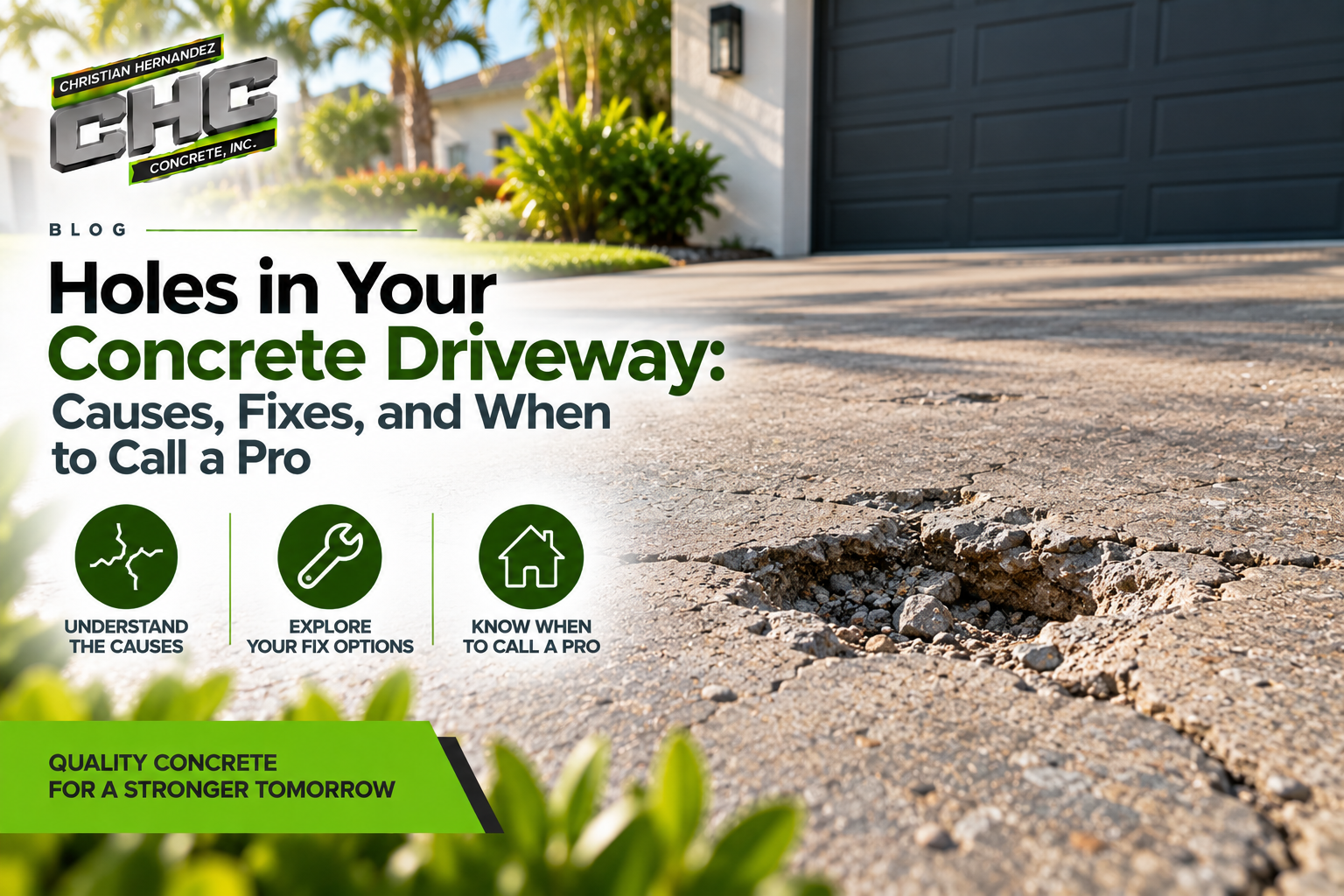
Your driveway takes a beating year after year. In Southwest Florida, that beating comes with an extra layer of punishment: relentless sun, saturated ground from seasonal storms, and the kind of humidity that works its way into every hairline crack. What starts as a minor surface flaw can turn into a structural problem faster here than in most other parts of the country.
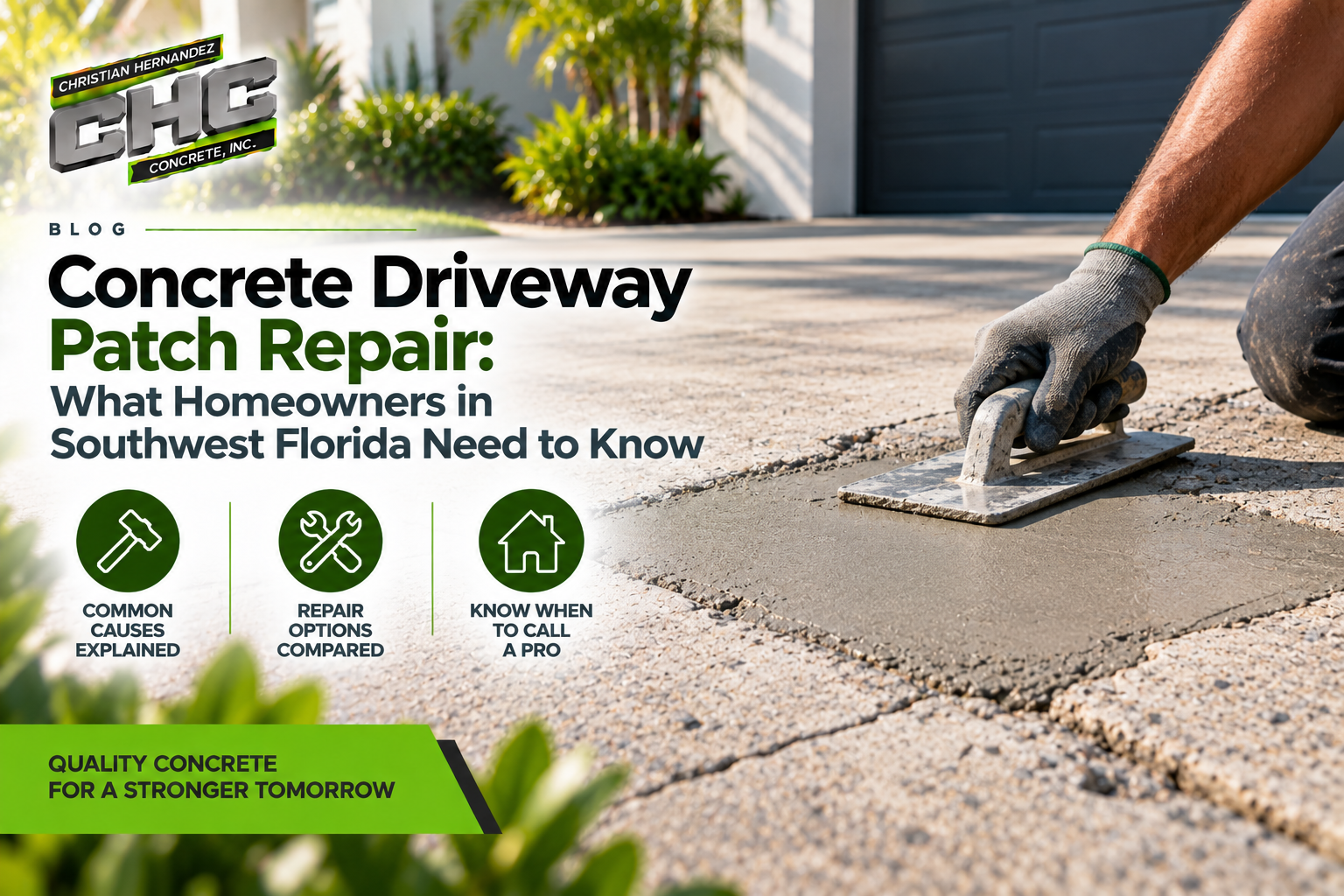
The good news is that concrete driveway patch repair is a legitimate, cost-effective solution — when it’s done right and at the right time. This guide walks you through everything you need to know: how to identify the damage, what options you have, when patching makes sense, and when it’s time to stop throwing good money after bad and consider a full replacement.
Why Concrete Driveways Crack in the First Place
Before you can fix the problem, it helps to understand what caused it. Concrete doesn’t crack randomly. There’s almost always a reason, and identifying that reason tells you whether a patch will hold or whether you’re dealing with something deeper.
Common causes of concrete driveway damage in SWFL:
- Shrinkage during curing — Concrete loses moisture as it hardens. If it wasn’t mixed or poured correctly, or if expansion joints were placed too far apart, shrinkage cracks form early.
- Ground movement and soil settlement — Florida’s sandy, moisture-sensitive soil shifts constantly, especially after heavy rain events. When the ground beneath a slab moves, the concrete above it follows.
- Tree root intrusion — Mature trees near a driveway will push roots under the slab over time, lifting and fracturing sections from below.
- Heavy vehicle loads — Standard residential concrete driveways are poured at 4 inches thick. Parking heavy trucks, RVs, or construction equipment repeatedly can overstress the slab.
- UV degradation and thermal expansion — Florida’s intense heat causes concrete to expand during the day and contract at night. Over years, this cycling weakens the surface and widens existing cracks.
- Poor original installation — Low water-to-cement ratio errors, improper curing, lack of reinforcement, or inadequate base preparation all shorten the lifespan of a driveway dramatically.
Understanding the cause isn’t just academic. If tree roots pushed your slab up, patching the surface without addressing the roots means you’ll be patching again in two years.
Assessing the Damage: Repair vs. Replace
This is where a lot of homeowners get stuck. The honest answer is that not all concrete damage is worth patching — and not all of it requires full replacement either. The decision comes down to the type, extent, and pattern of the damage.
| Damage Type | Repair Appropriate? | Notes |
|---|---|---|
| Hairline surface cracks (< 1/4 inch) | Yes | Sealable with crack filler or caulk-based products |
| Narrow cracks (1/4 – 1/2 inch) | Yes | Pourable crack fillers or mortar-based patching works well |
| Wide or deep cracks (> 1/2 inch) | Sometimes | Depends on cause; structural evaluation recommended |
| Spalling (surface flaking or pitting) | Yes, if localized | Resurfacing compounds can restore appearance and function |
| Sunken or heaved sections | Rarely | Root or soil issues must be resolved first |
| Widespread cracking or multiple failed patches | No | Replacement is usually more cost-effective long-term |
If more than 25–30% of your driveway surface shows active damage, or if you’re seeing cracks that run the full depth of the slab, a professional evaluation is worth the call before you spend anything on materials.
Types of Concrete Patching Materials
Walk into any home improvement store and you’ll find a wall of patching products. Not all of them perform equally — especially in Florida’s climate. Here’s what you’re actually choosing between.
Hydraulic cement is a fast-setting option that works well for filling large voids and holes. It expands slightly as it cures, which helps it bond in wet conditions. It’s not ideal for surface-level or shallow repairs.
Vinyl concrete patcher is one of the more popular DIY options. It’s a polymer-modified cement mix that bonds reasonably well to existing concrete and handles moderate surface repairs. Works best when applied at a minimum 1/4-inch thickness.
Epoxy-based patching compounds offer exceptional strength and adhesion. These are more expensive but hold up better in high-traffic areas. Epoxy patches resist oil, chemicals, and water intrusion more effectively than standard cement-based products.
Polyurethane foam (slab lifting) isn’t a patch in the traditional sense, but it’s worth mentioning. When a section of your driveway has sunk due to soil settlement, foam injection can raise it back to grade. This method is faster and less invasive than full slab replacement.
Concrete resurfacer works for widespread shallow damage — spalling, surface pitting, and general weathering. It’s applied thinly over the existing slab and creates a fresh bonded surface layer. Results depend heavily on proper prep work.
For concrete driveway repair jobs that go beyond surface-level patching, the material choice should be matched to the specific failure mode, not just whatever’s on sale at the hardware store.
Step-by-Step: How Concrete Driveway Patching Works
Whether you’re planning to DIY a small crack or want to understand what a contractor will do, the process follows a consistent sequence. Skipping steps — especially prep — is the number one reason patches fail prematurely.
1. Clean the damaged area thoroughly.
Remove all loose debris, dirt, and crumbling concrete. A wire brush, chisel, and angle grinder with a diamond cup wheel are the right tools here. Pressure washing helps, but the surface must be fully dry before patching unless you’re using a hydraulic cement product specifically rated for wet conditions.
2. Undercut the edges (for larger repairs).
This sounds counterintuitive, but cutting the crack or damaged area so that the edges are slightly wider at the bottom than at the top creates a mechanical key that holds the patch in place. Without this, the patch sits on top and peels off.
3. Apply a bonding agent.
For cement-based patches, a bonding adhesive brushed onto the prepared surface significantly improves adhesion. Let it become tacky before applying your patch material.
4. Mix and apply the patching compound.
Follow the manufacturer’s mix ratio exactly. Over-watering is common and weakens the final product. Press the material firmly into the crack or void, slightly overfilling to account for settlement during curing.
5. Finish and texture the surface.
If the patched area is visible, texturing it to match the surrounding concrete improves aesthetics. A broom finish on fresh patches blends better than a smooth trowel finish on a broomed driveway.
6. Cure properly.
Keep the patch moist for at least 24–48 hours, especially in Florida’s heat. Direct sun will pull moisture out of fresh concrete rapidly. Cover the area with plastic sheeting or burlap if possible.
7. Seal the repair.
Once cured, apply a penetrating concrete sealer over the patched area and ideally the surrounding surface. In SWFL’s climate, sealing is one of the smartest maintenance investments you can make.
Why Florida’s Climate Changes the Equation
This matters more than most national guides acknowledge. Standard patching advice written for northern climates doesn’t always translate to Florida conditions.
The ground in Southwest Florida is primarily sandy with high moisture absorption. After a storm event, that soil can shift enough to stress a slab. Unlike northern states, Florida doesn’t have freeze-thaw cycles — but it does have wet-dry cycles that are equally damaging over time. Water that enters a crack during rainy season expands the damage slowly, weakening the concrete bond from within.
UV exposure is another factor. Many patching compounds that work fine in moderate climates experience accelerated breakdown under Florida’s sun intensity. If you’re choosing a product for a concrete driveway in Fort Myers or Cape Coral, look specifically for UV-stabilized formulations or plan to seal aggressively after repair.
Algae and mold growth is also a real consideration. Southwest Florida’s humidity creates conditions where untreated concrete — especially patched areas with any surface porosity — will develop green or black staining within a season or two.
Common Patching Mistakes That Make Things Worse
Patching done incorrectly doesn’t just look bad — it can accelerate the underlying damage by trapping moisture or introducing new stress points.
Patching over structurally compromised concrete. If the slab beneath the crack is soft, hollow-sounding when tapped, or actively moving, no surface patch will hold. The base problem has to come first.
Using the wrong product for the application depth. Most patching products have minimum and maximum application thicknesses. Using a thin-set product to fill a 2-inch void, or applying a thick mortar mix at 1/8 inch, both lead to premature failure.
Skipping the bonding agent. The chemical bond between old and new concrete is the weakest point in any patch job. Bonding adhesive isn’t optional for quality results — it’s the difference between a repair that lasts three years and one that lasts three months.
Not controlling traffic too soon. Foot traffic should stay off patched areas for at least 24 hours. Vehicle traffic should wait a minimum of 72 hours, and ideally a full week for load-bearing repairs.
Ignoring the root cause. If soil erosion is causing settlement, if a tree root is the culprit, or if drainage is directing water under the slab repeatedly, the patch is temporary at best. Addressing the underlying issue is what makes any concrete repair last.
When to Call a Professional
Some patch jobs are genuinely DIY-friendly. A single hairline crack on a low-traffic section of your driveway? Manageable. But there are situations where calling a professional contractor pays for itself quickly.
- Multiple cracks forming a web or grid pattern across the slab
- Any section that has sunk, raised, or shifted
- Damage within 12 inches of the garage foundation or home slab
- Recurring patches that keep failing in the same location
- Driveways older than 25–30 years showing widespread surface deterioration
A professional isn’t just bringing labor — they’re bringing diagnostic experience. An experienced contractor can tell the difference between a shrinkage crack that’s stable and an active structural crack that will continue to grow. That distinction can save you from repeated repair costs on a driveway that actually needs replacement.
CHC Concrete has been working with Southwest Florida homeowners for over 35 years, handling everything from targeted driveway patch repairs to full concrete replacements across Fort Myers, Cape Coral, Naples, Bonita Springs, Estero, and the surrounding SWFL area. With 150+ five-star Google reviews, the reputation is built on giving homeowners straight answers — not overselling jobs that don’t need to be done.
If you’re unsure whether your driveway needs a patch or a full pour, that’s exactly the kind of call worth making before you spend money in the wrong direction.
Maintenance After Patching: Making the Repair Last
Getting the patch right is half the battle. Keeping it intact is the other half.
- Seal annually — Penetrating sealers prevent moisture infiltration and slow UV degradation. In Florida, annual sealing is a reasonable standard for any concrete driveway.
- Keep the surface clean — Oil and chemical spills degrade concrete over time. Clean spills promptly and avoid harsh degreasers that etch the surface.
- Manage drainage — Make sure water isn’t pooling against your driveway edges or flowing under the slab. Proper grading around the driveway protects the base layer.
- Watch for new cracks — Catching new damage early, when it’s still a hairline crack, is dramatically cheaper than addressing it after it’s opened up and allowed water in for a season.
- Avoid heavy equipment loading — Know your driveway’s load rating. If you’re having work done at your home that involves heavy machinery or dump trucks, protect the slab or expect to deal with the aftermath.
Frequently Asked Questions
How long does a concrete driveway patch last?
It depends on the quality of the prep work, the product used, and the underlying cause of the damage. A properly executed patch on stable concrete can last 5–10 years or more. A patch on compromised substrate, or one applied without proper bonding agent and surface prep, may fail within one to two years — especially in Florida’s climate.
Can I patch a concrete driveway myself?
For small, isolated cracks under 1/2 inch wide on a stable slab, DIY patching is reasonable. For anything involving sunken sections, wide structural cracks, or damage near the foundation, professional evaluation is the smarter first step.
What is the best concrete patching product for driveways?
Epoxy-based patching compounds offer the strongest, most durable bond and perform well in high-traffic and high-heat environments. Polymer-modified cement patchers (vinyl concrete patchers) are a solid middle-ground option for most residential surface repairs.
How much does concrete driveway patch repair cost?
Small DIY repairs can cost $30–$100 in materials. Professional patching for isolated damage typically runs $200–$600 depending on the scope. Larger areas, structural repairs, or resurfacing projects can range higher. In all cases, patching is significantly less expensive than full replacement, which justifies acting early.
How do I know if my driveway needs patching or full replacement?
If damage is isolated to one or two areas and the rest of the slab is structurally sound, patching is usually appropriate. If you’re seeing widespread cracking, multiple sunken sections, or recurring failures after previous repairs, replacement is likely the better long-term investment. A professional assessment is the most reliable way to make that call accurately.
CHC Concrete serves Southwest Florida homeowners in Fort Myers, Cape Coral, Naples, Bonita Springs, Estero, North Fort Myers, and surrounding communities. With 35+ years of experience in residential concrete driveways, patios, and pool decks, CHC delivers straight answers and lasting results — no upselling, no guesswork.
Ready to stop guessing and get a professional opinion on your driveway? Contact CHC Concrete today for an honest assessment and a straightforward estimate from a team that’s been doing this in Southwest Florida for over three decades.