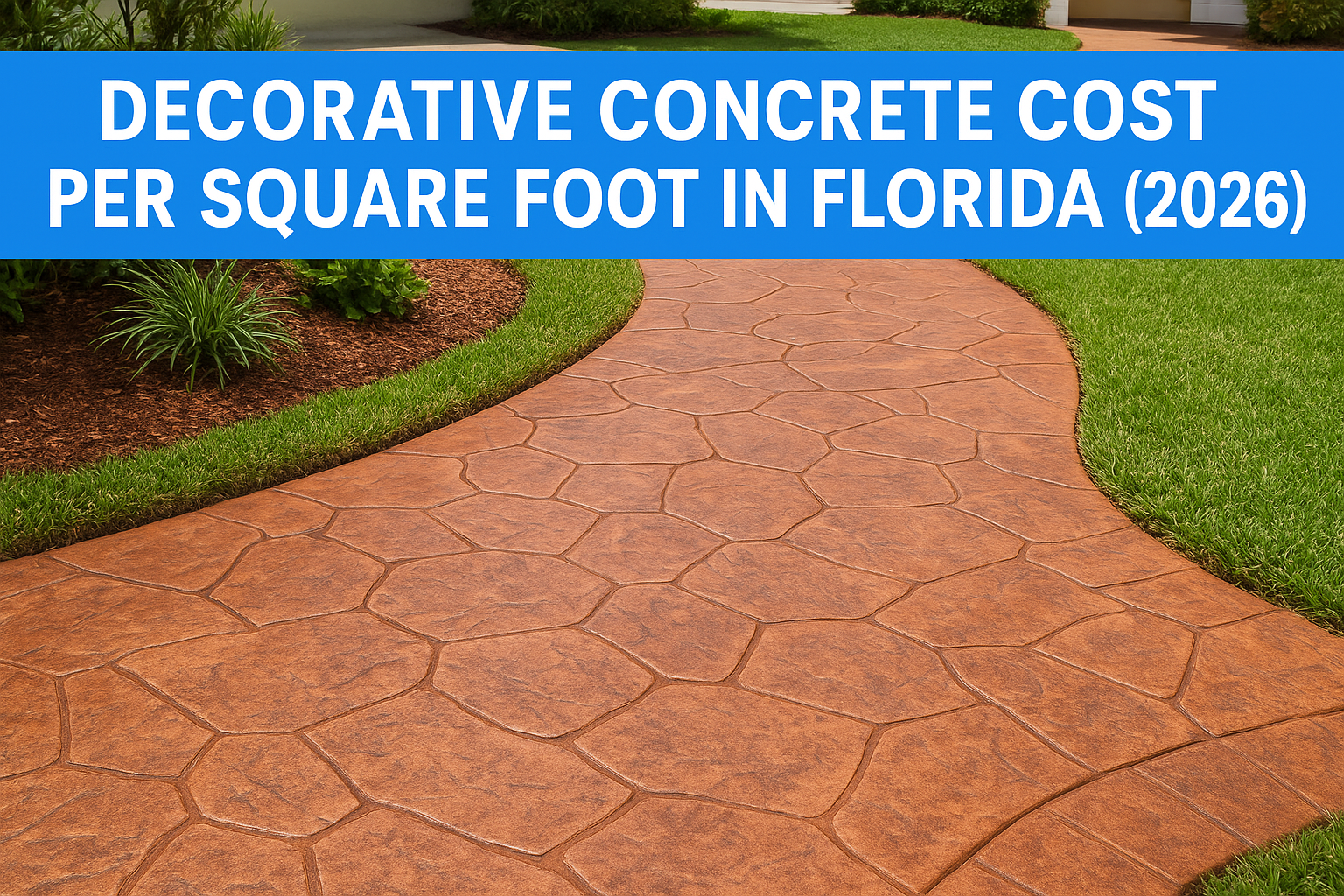
If you’re planning a decorative concrete project in Southwest Florida, the first question on your mind is probably cost. The decorative concrete cost per square foot depends on several factors, the type of finish you choose, the complexity of the design, your project’s size, and the prep work your site requires. Prices in Florida don’t always line up with national averages either, thanks to our unique soil conditions, humidity, and UV exposure that affect both materials and labor.
At CHC Concrete, we install stamped, stained, and overlay decorative concrete across Fort Myers, Cape Coral, Estero, and Bonita Springs. We’ve priced out hundreds of residential projects, so we know exactly where the numbers land locally, and where homeowners tend to get surprised. That hands-on experience is what this guide is built on, not recycled data from a generic cost calculator. We want you to walk into your project with realistic expectations and a clear budget.
This article breaks down current 2026 pricing for every major decorative concrete option, compares those costs against standard concrete and pavers, and explains what drives the price up or down. Whether you’re resurfacing a pool deck or pouring a new stamped driveway, you’ll have the numbers you need to make a confident decision, along with insight into what actually affects your bottom line here in Southwest Florida.
Why decorative concrete pricing varies in Florida
Florida is not the average market. Several factors specific to this state push decorative concrete costs above what you’ll see in national pricing guides, and understanding those factors helps you spot a realistic quote versus one that’s cutting corners somewhere. The three biggest drivers are climate exposure, soil conditions, and local labor and permitting requirements, and each one affects a different part of your project.
Florida’s climate puts more demand on materials
Southwest Florida’s heat and UV index are relentless on concrete surfaces year-round. Standard concrete sealers degrade faster here than they do in cooler climates, so contractors working in this market need to use UV-stable, penetrating sealers rated for high-temperature exposure. Those products cost more than the generic options a contractor in another climate might spec into a job.
The same applies to pigments used in stained or stamped decorative concrete. In Florida’s direct sun, lower-quality color systems fade within two to three years, so reputable installers use commercial-grade colorants that hold up under sustained UV load. That material upgrade protects your investment, but it adds to the per-square-foot cost upfront.
Florida’s intense UV and humidity mean that cutting costs on sealers or pigments today almost always results in a failing surface within a few years.
Humidity also slows curing in certain conditions. When moisture is high, concrete needs more time and careful monitoring to cure correctly, which affects scheduling and labor hours on site. Rushing a cure in Florida’s climate is one of the most common reasons decorative surfaces crack or delaminate early.
Sandy soil and drainage requirements raise prep costs
Southwest Florida sits on sandy, porous soil that shifts more than the clay-heavy ground found in other regions. That movement is one of the primary reasons decorative concrete cracks prematurely when it’s installed without proper base preparation. A well-engineered base typically requires deeper excavation, compacted fill, and in some cases a vapor barrier before any concrete is poured.
For decorative work, base preparation matters even more than it does for plain flatwork. You’re paying for a finished surface that’s meant to look good for years, so skipping or thinning the base to lower the quote is a false economy. Proper prep adds labor and material cost per square foot, but it’s what separates a decorative concrete installation that lasts from one that cracks within 18 months.
Many properties in Cape Coral, Estero, and Bonita Springs also have drainage requirements tied to lot grading. Before any concrete work begins, your contractor needs to account for how water moves across the surface, especially near pool decks and driveways where standing water creates both safety and structural problems.
Local labor and permitting in Southwest Florida
The Southwest Florida construction market has stayed competitive over the past several years, and licensed, insured concrete contractors in Fort Myers and Cape Coral reflect that market rate in their pricing. Lower bids often signal unlicensed work, reduced liability coverage, or both, which creates real financial and legal exposure for you as the property owner.
Certain decorative concrete projects, particularly driveways and structural flatwork, require a permit from the local municipality. Permitting adds a line item to your project budget, but it also ensures the work is inspected and meets Florida Building Code standards. When you’re comparing quotes, confirm whether permitting fees are included, because that omission can shift your actual decorative concrete cost per square foot by several dollars depending on your project size.
Average decorative concrete cost per sq ft in Florida
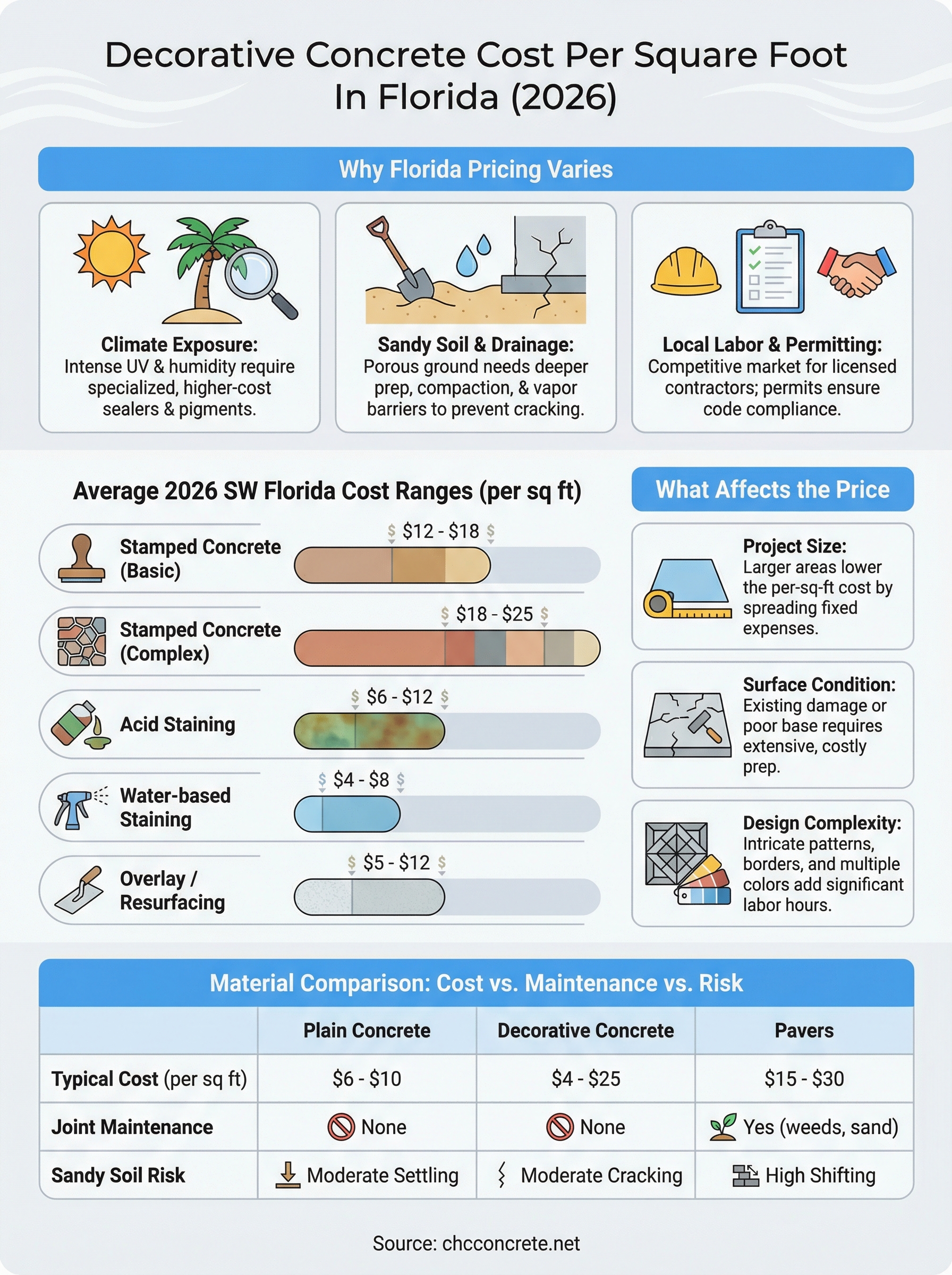
Florida pricing for decorative concrete runs higher than national averages for the reasons covered above, but the numbers still fall within a predictable range depending on the finish type. The table below gives you a realistic starting point for current 2026 pricing in Southwest Florida, covering the three most common decorative options CHC Concrete installs across Fort Myers, Cape Coral, Estero, and Bonita Springs.
| Finish Type | Low End (per sq ft) | High End (per sq ft) |
|---|---|---|
| Stamped concrete (basic pattern) | $12 | $18 |
| Stamped concrete (complex pattern) | $18 | $25 |
| Acid staining | $6 | $12 |
| Water-based staining | $4 | $8 |
| Overlay / resurfacing | $5 | $12 |
These ranges include materials, labor, and a standard sealer application. They do not include permitting fees or significant site prep costs, which vary by property.
Stamped concrete costs in Florida
Stamped concrete sits at the higher end of the decorative concrete cost per square foot range because it requires more skilled labor and a longer installation window. Basic single-pattern work with one color typically lands between $12 and $18 per square foot. When you add multiple colors, intricate borders, or patterns that mimic stone or tile, expect to push toward $20 to $25 per square foot. Pool decks and driveways with custom layout work sit at that upper range most often.
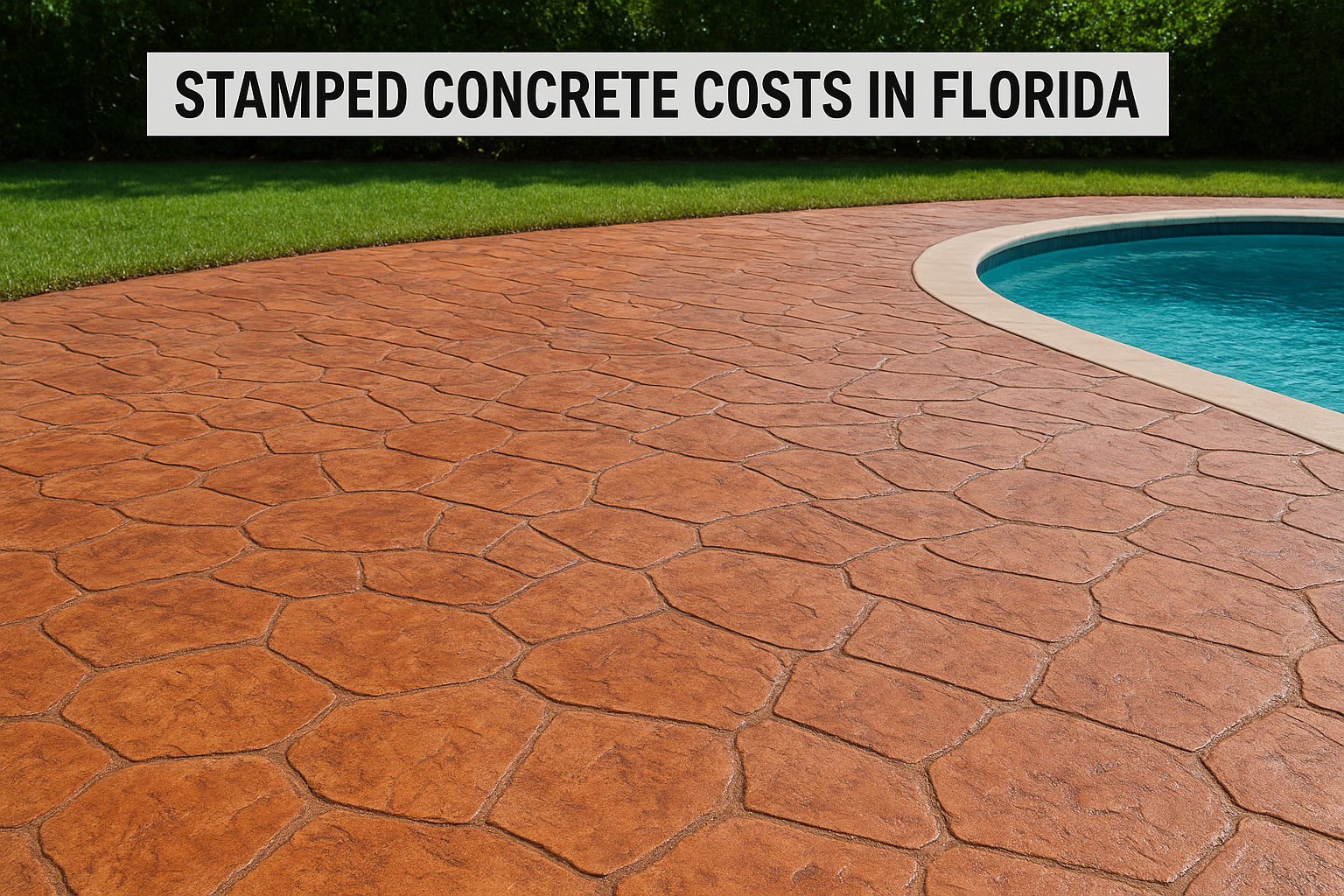
The complexity of the pattern, not just its size, is what drives stamped concrete labor costs up in Florida.
Stained concrete costs in Florida
Staining is the most affordable way to add significant visual interest to an existing or new concrete surface. Acid staining produces organic, mottled color variation that many homeowners prefer for outdoor living spaces, and it typically runs $6 to $12 per square foot in Southwest Florida. Water-based staining is more predictable in tone and comes in at $4 to $8 per square foot, making it a practical choice for larger surface areas where budget matters.
Overlay and resurfacing costs in Florida
Concrete overlays give you a decorative finish without tearing out an existing slab. Pricing typically falls between $5 and $12 per square foot depending on the overlay thickness, texture, and whether color is incorporated. Resurfacing a pool deck with a spray-texture or knockdown finish sits at the lower end of that range, while a full microtopping or decorative overlay with pattern work pushes higher.
What changes the price per square foot
Several variables shift your decorative concrete cost per square foot beyond the base finish type. Knowing these factors in advance helps you understand why two seemingly similar projects can come back with very different quotes, and it tells you what to ask when you’re reviewing bids.
Project size
Square footage affects your per-square-foot cost more than most homeowners expect. Larger projects spread fixed costs like equipment setup, mixing, and crew mobilization across more surface area, which lowers the price per square foot. A 200-square-foot patio will cost more per square foot than a 600-square-foot driveway using the same finish, because the contractor’s time and overhead don’t scale linearly with size.
Requesting quotes for your actual square footage matters. Generic online estimates don’t account for how size changes the math on a real job.
Smaller decorative projects also leave less room to correct layout mistakes, so skilled labor becomes a bigger portion of the overall cost. If your project is under 150 square feet, expect to sit at the higher end of any pricing range you’ve seen.
Surface condition and required prep work
The condition of the surface you’re starting with has a direct impact on your final cost. New pours require proper excavation, base compaction, and reinforcement before any decorative work begins, and the depth and scope of that prep depends on your soil and drainage situation. In Southwest Florida’s sandy soil, base work is rarely minimal.
For resurfacing and overlay projects, existing concrete must be assessed for cracks, delamination, and structural integrity before anything goes on top. Surface damage that needs repair before an overlay adds labor hours and materials to your project. A contractor who skips that inspection and applies a new surface over failing concrete is saving time at your expense.
Design complexity and color choices
Pattern layout, color combinations, and border details all add time to the installation process. A single stamped pattern in one color requires far less coordination than a two-tone stamped field with a hand-cut border, and that difference shows up in the final price. Custom color mixes that require on-site blending or multiple-step application processes add both materials and skilled labor hours.
Intricate layouts also increase the risk of misalignment, which means your contractor needs to move more carefully and methodically. That precision takes time, and time is the biggest driver of labor cost on any decorative concrete project.
Decorative concrete vs plain concrete and pavers
When you’re comparing your options, the decorative concrete cost per square foot often gets stacked against plain concrete or pavers without accounting for the full picture. Each material carries different installation costs, maintenance demands, and longevity profiles, and understanding where they actually stand against each other helps you make the right call for your specific project and budget in Southwest Florida.
Decorative concrete vs plain concrete
Plain concrete in Southwest Florida typically runs $6 to $10 per square foot installed, which is noticeably lower than most decorative finishes. That gap in upfront cost is real, but plain concrete gives you no control over appearance and tends to look flat and utilitarian on a residential pool deck or driveway. The functional performance between the two is similar, but decorative concrete adds visual value that translates directly to curb appeal and what a buyer sees when they walk your property.
Paying more upfront for a decorative finish isn’t just about looks. It’s an investment in a surface that holds its value longer than plain gray concrete.
From a long-term standpoint, both finishes require periodic resealing, typically every two to four years under Florida’s heat and UV load. The ongoing maintenance cost per square foot is comparable between the two, so the additional spend at installation doesn’t compound into higher yearly upkeep. You pay more once and get a substantially better result that holds its appearance over time.
Decorative concrete vs pavers
Pavers are the most common alternative homeowners consider for driveways and pool decks. Paver installation in Southwest Florida typically falls between $15 and $30 per square foot, depending on the paver material and pattern complexity. That puts basic stamped concrete and staining below or on par with pavers at the entry level, while complex stamped layouts sit in a comparable range.
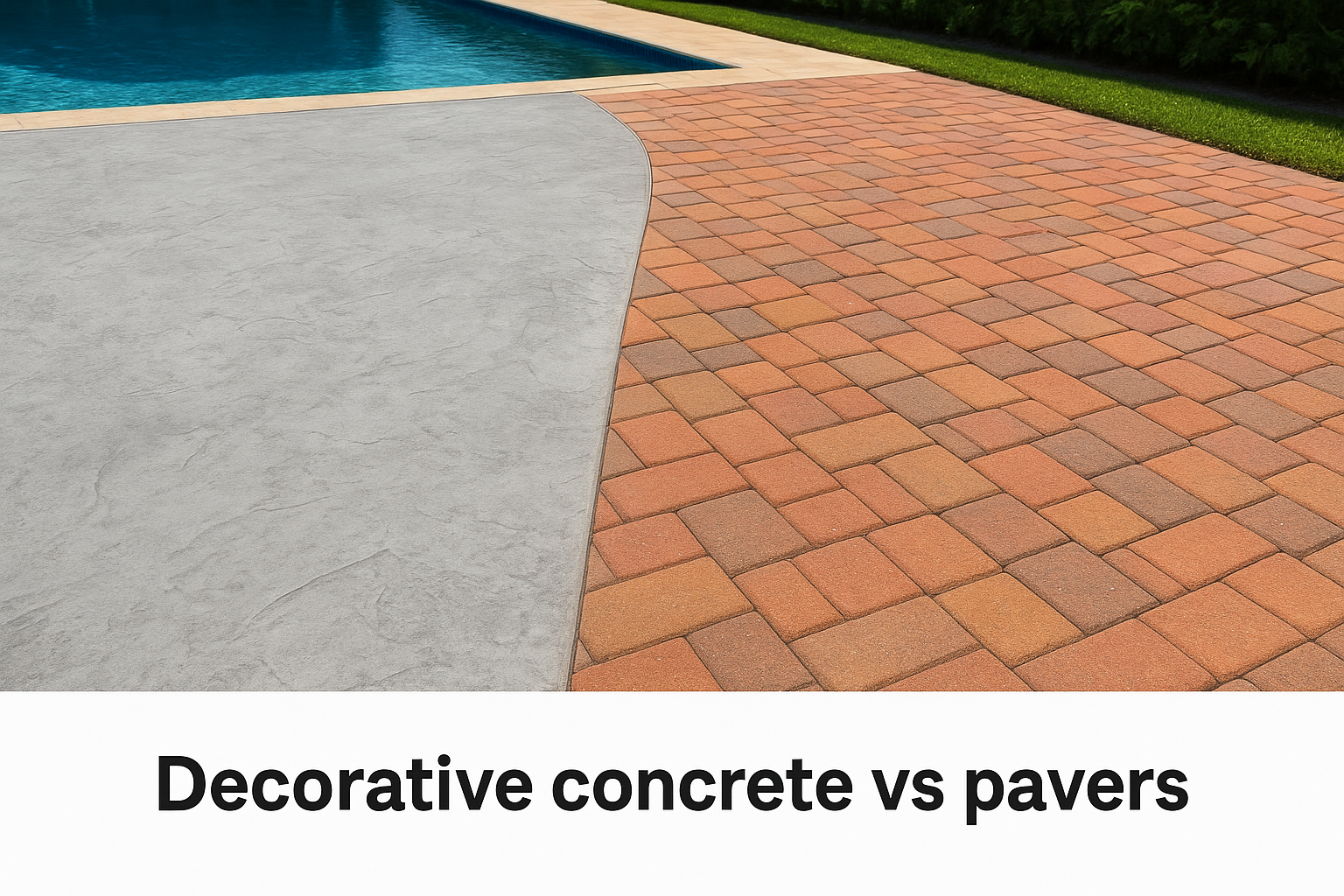
The maintenance comparison is where decorative concrete pulls ahead for many Florida homeowners. Individual pavers shift and settle in sandy soil, allow weed growth between joints, and require periodic resetting and sand replacement. Decorative concrete is a continuous surface with no joints to manage, though it does require sealing and occasional crack repair. Over a 10-year window, that difference in ongoing maintenance adds up.
| Material | Typical Cost (per sq ft) | Joint Maintenance | Sandy Soil Risk |
|---|---|---|---|
| Plain concrete | $6-$10 | None | Moderate settling |
| Decorative concrete | $4-$25 | None | Moderate cracking |
| Pavers | $15-$30 | Yes | High shifting |
How to budget and get accurate quotes in Florida
Building a realistic budget for decorative concrete starts before you ever call a contractor. Knowing your square footage and the finish type you want gives you enough information to set a working budget range using the numbers in this article. From there, your job is to collect multiple quotes from licensed contractors and compare them against that baseline, not against each other in isolation.
Start with your square footage and finish type
Measure the area you’re working with as accurately as you can before reaching out to contractors. Irregular shapes like curved pool decks or L-shaped driveways are harder to estimate, and contractors will quote them differently depending on how they factor in the complexity of working around edges and angles. Having your own rough measurement lets you catch significant discrepancies between quotes early.
Once you have your square footage, choose a finish type that fits both your goals and your budget range. Staining and overlays carry lower decorative concrete cost per square foot than stamped work, so if your budget is tight, starting with those options gives you a realistic picture of what’s achievable without stretching your finances.
Getting quotes for the same finish type across multiple contractors is the only way to tell if a price is competitive or if something is being left out.
What a complete Florida quote should include
A written quote from a licensed Southwest Florida contractor should clearly spell out what’s covered. Vague quotes that list only a total price are a warning sign, because they give you no way to verify what’s included or to compare line items against another contractor’s offer. Ask for an itemized breakdown before agreeing to anything.
A complete quote should cover the following:
- Materials: concrete mix, colorants, release agents, reinforcement
- Labor: crew size, estimated days on site, and finishing hours
- Sealer: product type and number of coats included
- Prep work: excavation depth, base compaction, and crack repair if resurfacing
- Permitting: whether fees are included or billed separately
Questions to ask before signing
Asking direct questions during the quoting process saves you from expensive surprises after work starts. Confirm that your contractor is licensed and insured in Florida, and ask specifically whether the quote covers the full scope of prep work your site requires.
Two questions worth asking every contractor you meet with:
- What happens if the slab develops a crack within the first year? A reputable contractor will have a clear answer about how they handle warranty claims.
- What sealer product are you using, and how long does it last under Florida sun? The answer tells you whether they’re specifying materials for this climate or defaulting to whatever is cheapest.
Next steps for your Florida project
You now have a clear picture of what decorative concrete costs per square foot across every major finish type, what drives those numbers up or down, and how to evaluate the quotes you receive. Understanding the decorative concrete cost per square foot before you start means you won’t get caught off guard when proposals land in your inbox. The most important next step is simple: get written, itemized quotes from licensed contractors who know Southwest Florida’s soil, drainage, and permitting requirements specifically.
Don’t rely on national pricing tools or estimates from contractors outside this market, because those numbers won’t reflect the materials and prep work your project actually needs. If your project involves a pool deck, driveway, patio, or any concrete surface in Fort Myers, Cape Coral, Estero, or Bonita Springs, CHC Concrete works in your area and provides free on-site estimates. Request your free concrete estimate from CHC Concrete and get accurate local pricing for your specific project.