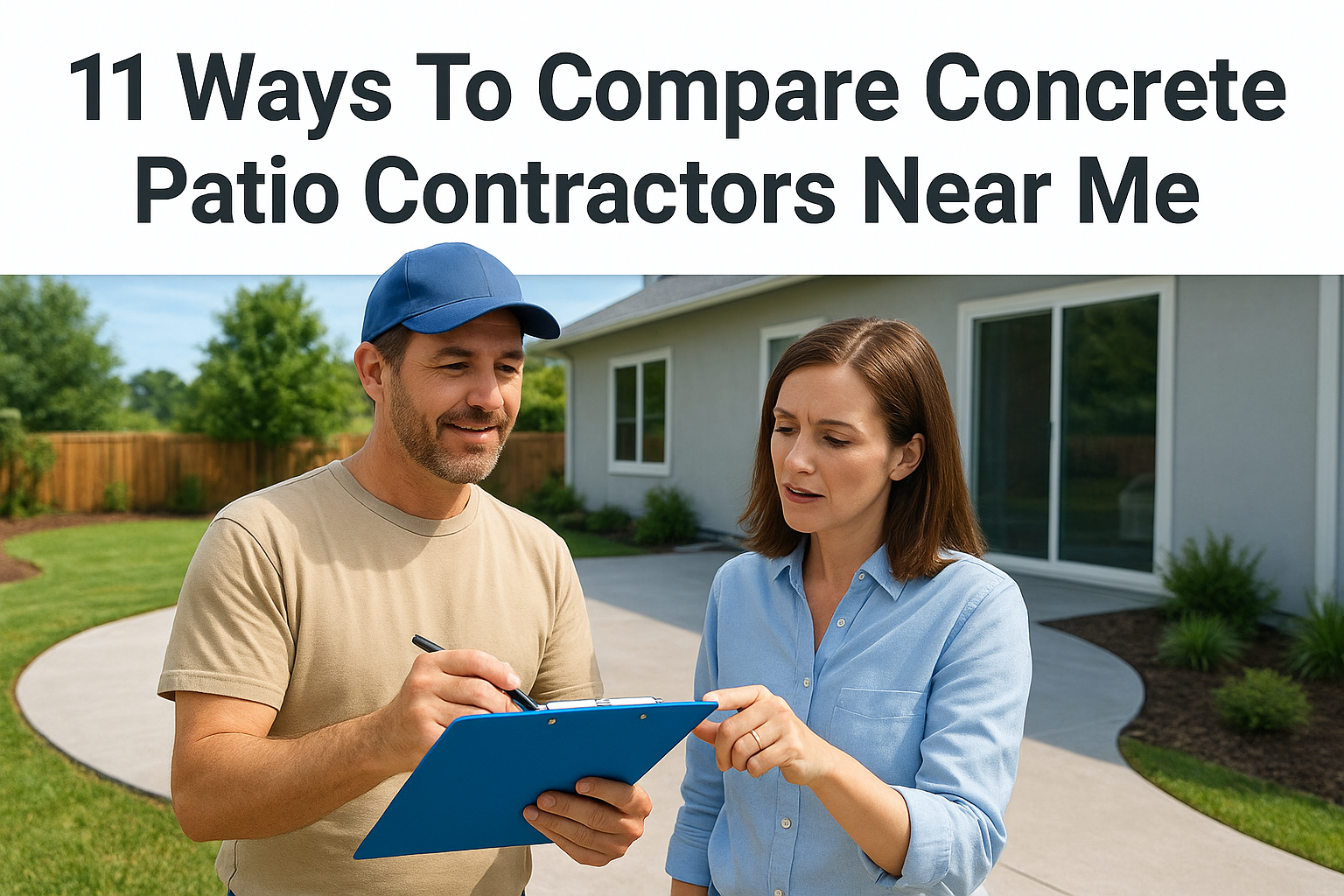
Searching for concrete patio contractors near me pulls up dozens of results, ads, directories, review sites, and contractor pages all competing for your attention. The problem isn’t finding options. It’s figuring out which contractor actually deserves your money. A concrete patio is a permanent addition to your property, and a bad hire can leave you with cracking slabs, poor drainage, or a project that doesn’t meet code.
At CHC Concrete, we’ve been pouring patios across Fort Myers, Cape Coral, Estero, and Bonita Springs long enough to know what separates a solid contractor from one who cuts corners. We also know that homeowners deserve a straightforward way to evaluate their options before signing anything. That’s exactly why we put this guide together, not to tell you to hire us, but to give you the tools to make a confident decision on your own.
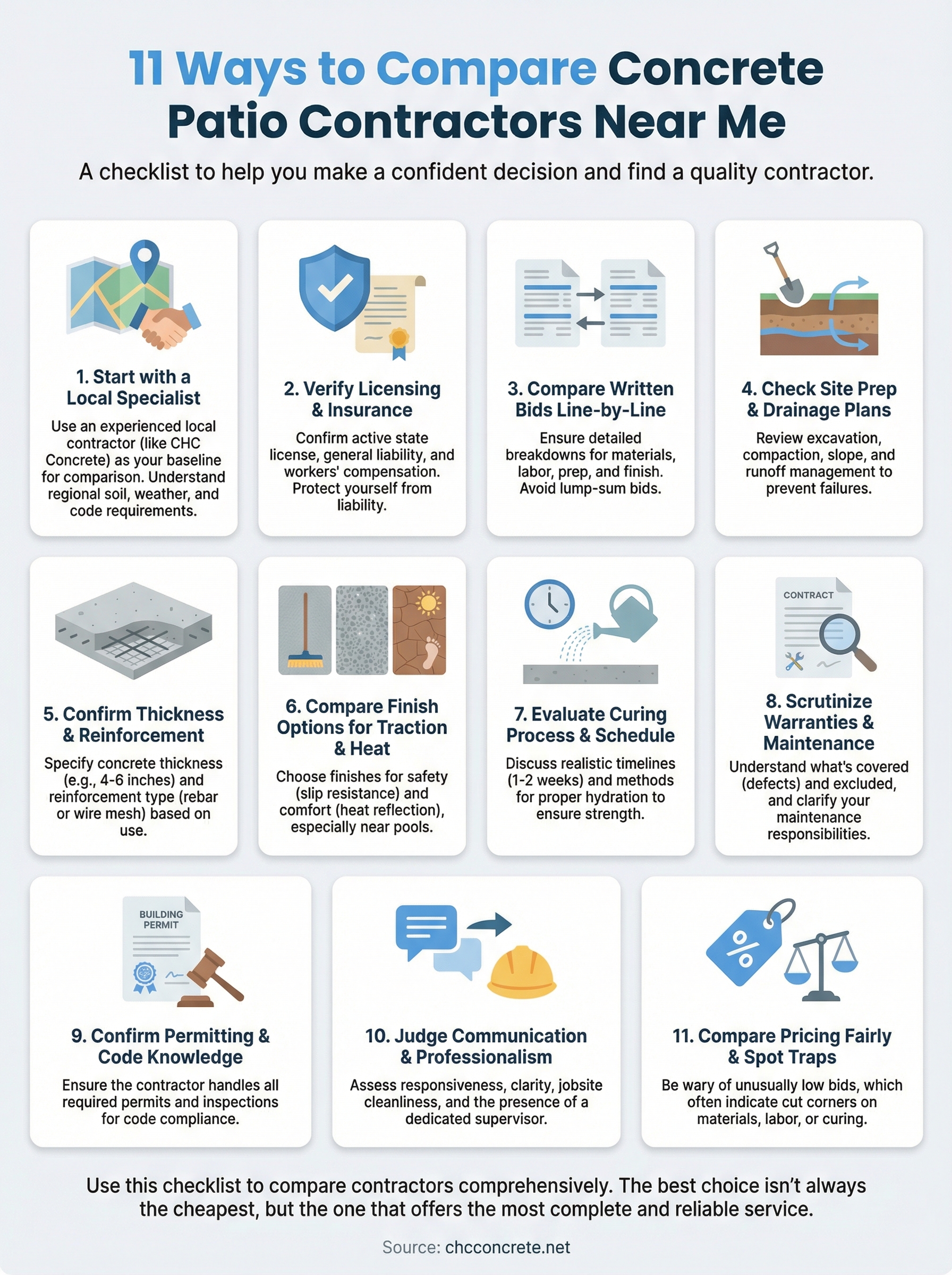
Below, you’ll find 11 specific ways to compare concrete patio contractors in your area. Each one covers a factor that directly affects the quality of work you’ll get, from licensing and insurance to how a contractor handles Southwest Florida’s unique soil and weather conditions. Use them as a checklist before you commit to any estimate or contract.
1. Start with a local specialist like CHC Concrete
Before you start comparing every concrete patio contractors near me result you find online, anchor your process with at least one contractor who already understands your local conditions. In Southwest Florida, sandy soil, heavy seasonal rainfall, and intense UV exposure all play a direct role in how a patio gets designed, reinforced, and finished. A contractor without that regional knowledge can quote you a price that looks competitive while specifying a build that won’t hold up past the first rainy season.
Use a local specialist as your comparison baseline
A local specialist gives you a reference point that out-of-area crews simply cannot match. CHC Concrete engineers its pours and base preparations specifically for the conditions found in Fort Myers, Cape Coral, Estero, and Bonita Springs. When you use their estimate as your baseline, every other bid you collect gets measured against the same local standards, not generic specs pulled from a national template or a contractor who last worked two states away.
Using a locally experienced contractor as your comparison baseline gives you a realistic quality benchmark before you evaluate anyone else.
Questions to ask before you schedule an onsite estimate
Asking the right questions before any contractor arrives filters out poor fits fast. Find out how long each contractor has worked in your specific county and what base materials they use for Southwest Florida soil conditions. You should also confirm whether they carry current licensure and insurance for residential concrete and whether they pull permits when the project requires them. Any contractor who dodges those last two questions is one worth moving past quickly.
Here are four specific things to clarify before booking an estimate:
- Soil preparation method and base depth for your lot
- Reinforcement approach for Florida’s wet-dry climate cycles
- Timeline from permit to final pour, including cure time
- Who supervises the crew on your property day to day
How to compare other bids to the same scope and specs
Once your baseline contractor provides a detailed written estimate, send that same project description to every other contractor you evaluate. Include the square footage, intended use, finish type, and any drainage requirements specific to your property. When each contractor bids against identical scope and specs, you can read line items side by side rather than reconciling quotes that describe fundamentally different jobs. This single step eliminates the most common comparison mistake homeowners make before signing a contract.
2. Verify licensing and insurance
Licensing and insurance are two non-negotiable requirements before you hand any contractor a deposit. When you compare concrete patio contractors near me, you’ll find operators who skip one or both. That shortcut shifts significant financial and legal risk onto you if something goes wrong during or after the job.
What to verify and where to check it
Florida requires concrete contractors to hold a state-issued contractor’s license, which you can verify through the Florida Department of Business and Professional Regulation (DBPR). Ask each contractor for their license number before the first site visit and confirm it shows active status in the correct trade category. Verify this yourself rather than accepting the contractor’s word for it.
Here’s what to confirm before scheduling any estimate:
- Active license status in the correct trade category
- Business name on the license matches the company billing you
- No active complaints or disciplinary actions on the record
What coverage you should expect for patio work
Every contractor working on your property should carry general liability insurance and workers’ compensation coverage. General liability protects your property if the crew causes accidental damage during the job. Workers’ compensation covers injuries to crew members on your lot so you don’t face a personal injury claim tied to your property.
Skipping the insurance verification step is one of the most common and costly mistakes homeowners make when hiring concrete contractors.
Red flags that signal you should walk away
Watch for contractors who refuse to share license numbers or only produce proof of insurance after repeated requests. Any contractor offering a price that feels unusually low may be cutting costs by working without proper licensing or coverage, which puts your property and your finances directly at risk.
3. Compare written bids line by line
A verbal quote tells you almost nothing useful. Every contractor you consider should provide a detailed written bid that breaks the project into specific line items. Without written documentation, you have no way to confirm what you’re paying for or hold anyone accountable when the final invoice arrives.
Bid sections every estimate should include
Every written bid should list materials, labor, base preparation, finishing, and cleanup as separate line items. Concrete mix design, reinforcement type, and slab thickness should each appear explicitly. If a bid groups everything into one number, push back and ask for the full breakdown before you move forward.
A lump-sum bid almost always hides assumptions that favor the contractor, not you.
How to normalize bids so you compare apples to apples
When you compare concrete patio contractors near me, different bids often describe different scopes. One contractor might include grading and haul-off while another assumes the lot is already prepped. List each line item in a column and mark what each bid covers for every category so the comparison becomes direct and clear.
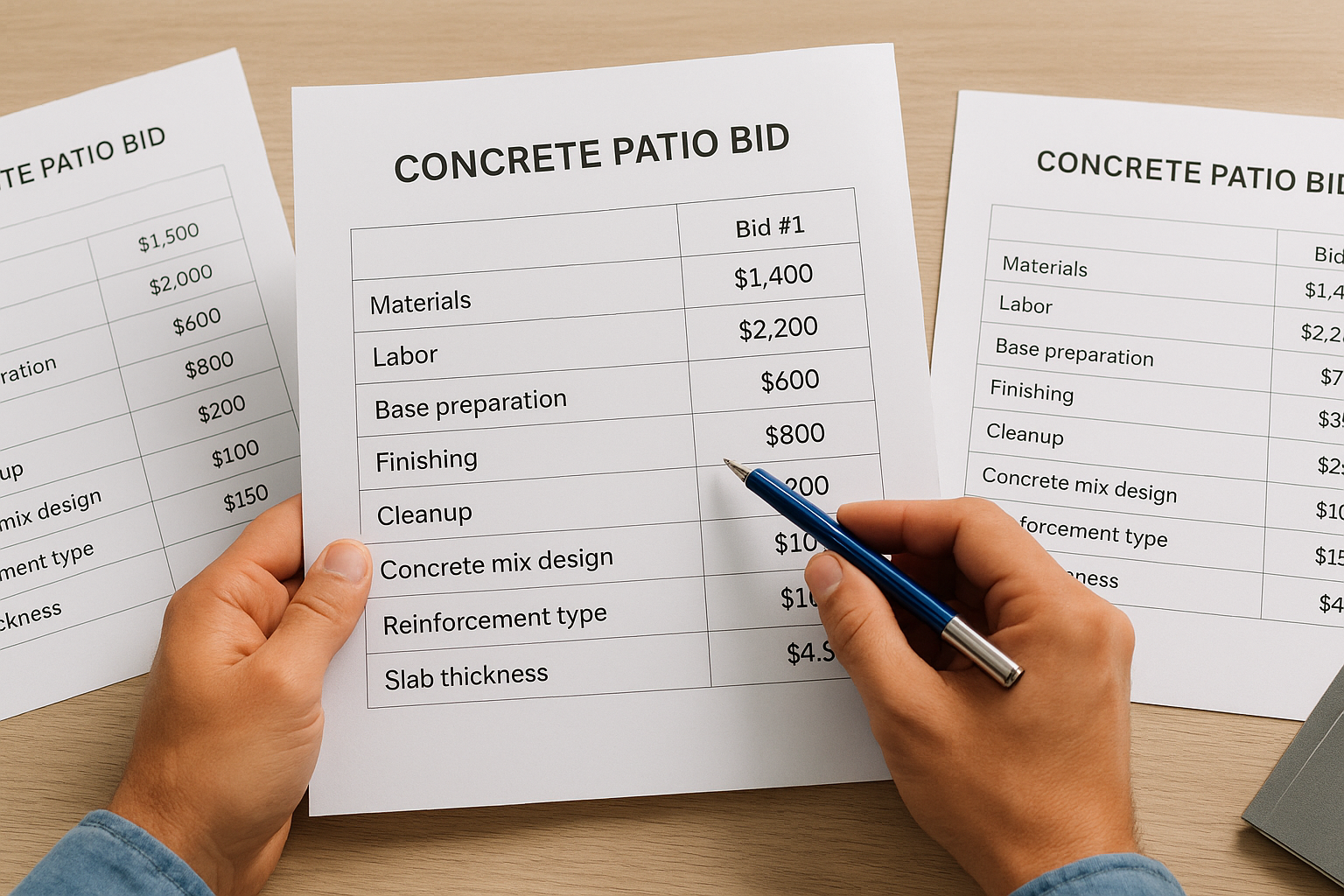
Items to track across all bids:
- Site grading and debris haul-off
- Base material type and depth
- Concrete thickness and mix design
- Reinforcement method
- Finishing and sealing
Change order language that protects you
Read the change order clause in every contract before signing. It should require written approval from you before any additional work starts. Any contract that lets a contractor proceed and bill you later puts your total cost entirely beyond your control.
Before signing, confirm these points:
- Written authorization required before extra work begins
- Unit pricing for additions stated upfront
- Both parties sign off on each change
4. Check site prep and drainage plans
Site prep is where most concrete patio failures actually start. A contractor who rushes past grading, compaction, and drainage planning is setting your slab up for cracking, heaving, or water damage. When comparing concrete patio contractors near me, ask each one to walk you through their prep process before you agree to anything.
What proper subgrade and base prep looks like
Every quality patio starts with proper excavation and soil compaction below the finished surface. The contractor should remove organic material, establish a stable subgrade, and install compacted base material at the correct depth for your specific soil and load requirements. Any contractor who skips those steps is building directly on a surface that will shift.
How contractors should handle slope, runoff, and pooling
Your patio needs a minimum slope away from your home’s foundation so water drains consistently and doesn’t pool on the surface. A qualified contractor will calculate surface pitch and direct runoff toward a designated drainage path rather than your yard or your neighbor’s property. Ask each contractor to show you their drainage plan on paper before work starts.
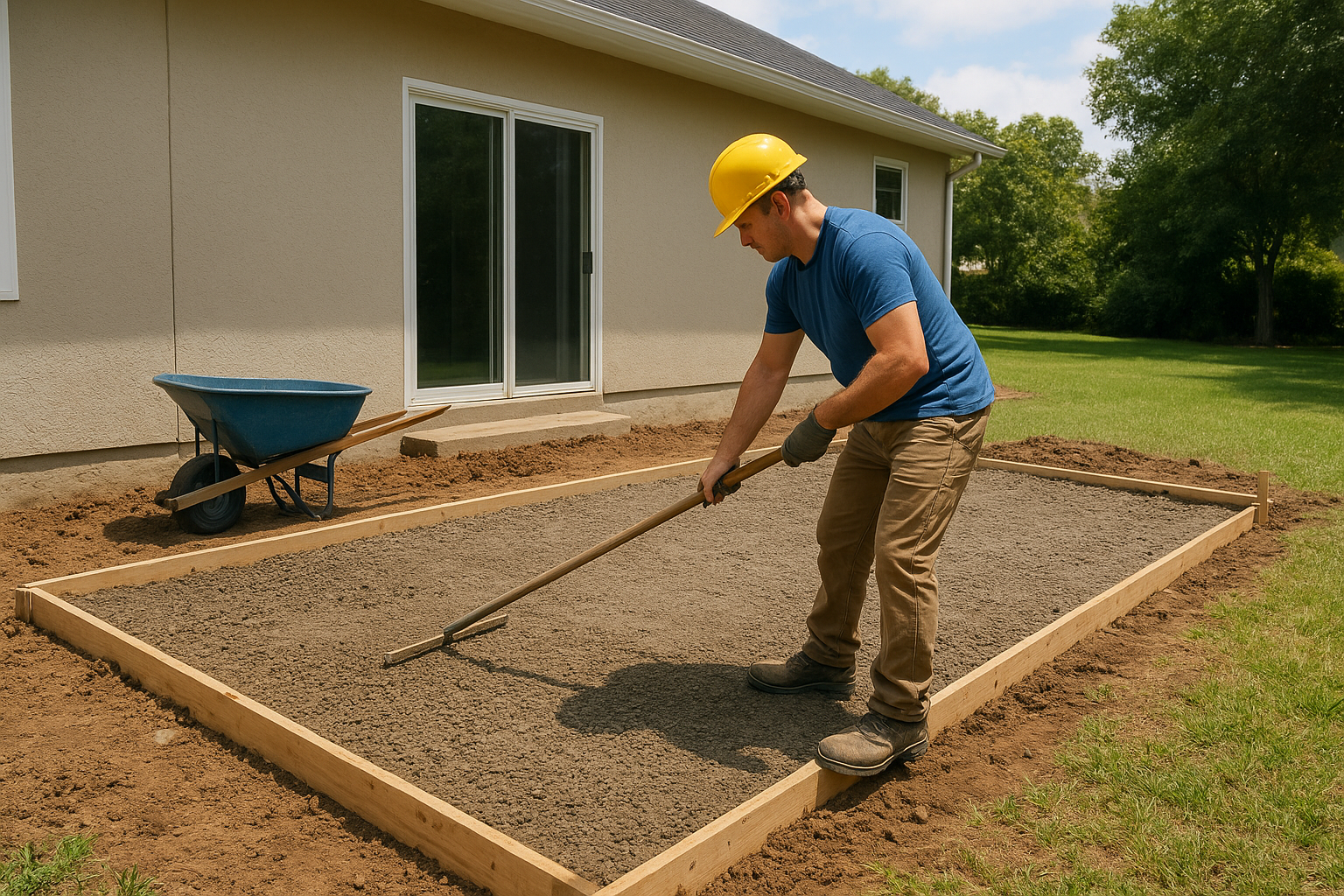
Drainage planning is not optional in Southwest Florida. Without it, standing water will degrade even a well-poured slab within a few years.
Southwest Florida soil and rainfall factors to ask about
Florida’s sandy, loosely compacted soil shifts more than soil in most other regions, especially after heavy rainfall. Contractors in Fort Myers, Cape Coral, and surrounding areas must account for seasonal saturation cycles that cause soil to expand and contract repeatedly throughout the year. Ask each contractor how they adjust base depth and drainage specifically for those conditions on your lot.
5. Confirm thickness and reinforcement details
Thickness and reinforcement are two details that separate a patio that lasts decades from one that starts cracking within a few years. When you compare concrete patio contractors near me, ask each one to specify both in writing before work starts.
How patio thickness should match the use case
A standard residential patio typically calls for 4 inches of concrete, but that number changes based on what you plan to put on it. If you’re parking a vehicle, storing heavy outdoor equipment, or building over soft Florida soil, 4 to 6 inches may be the minimum you should accept. Ask each contractor to justify their recommended thickness based on your specific use case, not a one-size-fits-all default.
Thickness is one of the easiest corners to cut because you can’t see it once the slab is poured, which is exactly why you need it specified in writing before work starts.
Reinforcement options and when each one makes sense
Rebar and wire mesh are the two most common reinforcement methods, and each serves a different purpose. Rebar provides structural strength and works best for thicker slabs or areas with softer subgrades. Wire mesh controls shrinkage cracking in standard residential slabs and costs less. Ask your contractor which method they recommend and why, based on your soil conditions and patio use.
Control joints, expansion joints, and crack expectations
Control joints cut into the surface at planned intervals to direct cracking along predictable lines rather than across random sections of your slab. Expansion joints separate the patio from adjacent structures like your home’s foundation to allow for natural movement. Ask each contractor how many joints they plan to cut and at what spacing for your specific layout.
6. Compare finish options for traction and heat
The finish on your patio affects daily safety and surface temperature, not just appearance. When you compare concrete patio contractors near me, ask each one what finish they recommend and why it fits your specific use case before you agree to anything.
Finish types and how they change performance and look
Broom finishes create a textured surface that grips foot traffic and resists slipping in wet conditions, making them the most practical choice for most residential patios. Exposed aggregate and stamped concrete add visual texture and can reduce heat absorption compared to a plain smooth finish. Ask your contractor to show you physical samples before you commit to any finish type.
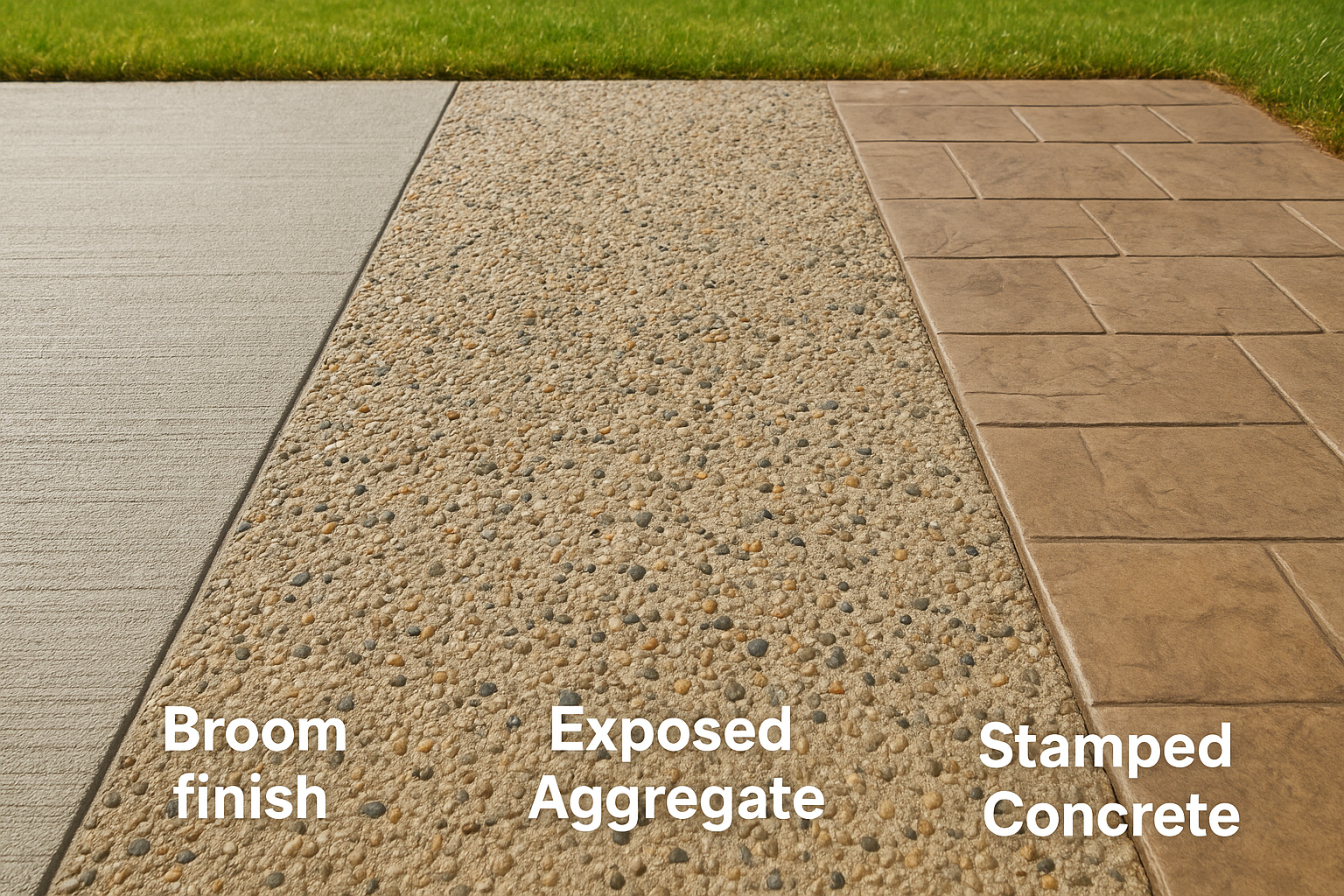
Pool-adjacent safety and slip resistance considerations
If your patio connects to a pool deck, slip resistance becomes a code requirement, not just a preference. A brushed or troweled texture reduces the risk of falls on wet surfaces, and your contractor should be able to specify which finish ratings they use for wet-zone applications.
Choosing the wrong finish near a pool is a liability issue, not just an aesthetic one.
Sealing choices and what they do in intense sun and rain
Penetrating sealers protect the concrete from within by blocking moisture without leaving a film on the surface, which reduces peeling over time. Topical sealers add a protective layer that can enhance color but require reapplication every few years under Florida’s intense UV exposure. Ask your contractor to specify the sealer type, coverage rate, and recommended reapplication schedule in writing before work begins.
7. Evaluate curing process and schedule realism
When you compare concrete patio contractors near me, many homeowners focus entirely on price and overlook the curing process. Curing determines how strong and durable your finished slab becomes, and any contractor who rushes it or skips it entirely will hand you a weaker surface than what your investment should produce.
What a realistic install timeline includes
A complete patio project involves more steps than just the pour itself. Your contractor should give you a written schedule that covers excavation, base prep, forming, pouring, curing, and sealing as separate phases. For a standard residential patio, expect the full process to take at least one to two weeks when proper curing time is included, not two days from start to finish.
A contractor who promises a finished, sealed patio within 48 hours is cutting the curing phase short, which directly reduces the slab’s long-term strength.
What “proper curing” means and why it affects durability
Concrete reaches its full design strength through a controlled hydration process that requires consistent moisture and temperature over several days. Rushing that process by letting the slab dry too fast causes surface scaling and internal cracking. Ask each contractor specifically how they maintain moisture during the first 7 days after the pour and what materials or methods they use.
Weather planning and how contractors protect fresh pours
Florida’s afternoon storms can compromise fresh concrete within minutes if the crew pours without checking the forecast. Your contractor should explain how they monitor weather windows and what protective coverings they use if rain arrives before the surface sets.
8. Scrutinize warranties and maintenance terms
When you compare concrete patio contractors near me, warranties often get treated as an afterthought. They should not be. A warranty tells you exactly how much confidence a contractor has in their own work, and reading it carefully before you sign the contract protects you if the slab develops problems down the line.
What a solid workmanship warranty covers and excludes
A workmanship warranty should cover defects caused by improper installation, including premature cracking, surface scaling, and joint failures that result from errors during the pour or finish phase. Read the exclusions closely. Most warranties exclude cracks caused by tree roots, ground movement, or third-party modifications, which is reasonable. Any warranty that excludes so much that nothing is actually covered is not worth the paper it’s written on.
A warranty with vague language almost always favors the contractor when a dispute arises, so push for specific, written terms before signing.
Maintenance responsibilities you should accept or reject
Some contracts shift resealing, joint refilling, and surface cleaning obligations onto you as the homeowner, which is fair. What you should push back on is any clause that voids the warranty if you skip a maintenance step the contractor never explained or documented at project closeout.
How to document the job so warranty claims stay simple
Take dated photographs of every phase, from the base prep through the final sealed surface. Ask your contractor for a written closeout package that includes the mix design, joint locations, sealer product, and cure method used. That documentation makes any future warranty claim straightforward rather than a word-against-word dispute.
9. Confirm permitting and code knowledge
When you compare concrete patio contractors near me, permitting knowledge is one of the clearest ways to separate qualified professionals from operators who cut corners. In Florida, building permits protect you by ensuring your project gets inspected and meets local safety codes before the slab is finished.
When patios need permits and what can trigger them
Not every patio requires a permit, but several factors can push a project into permit territory in Southwest Florida. Ask your contractor directly whether your specific project requires one and get their reasoning in writing before work starts.
Common triggers include:
- Square footage that exceeds your county’s threshold
- Proximity to property lines or easements
- Connection to existing drainage or utility infrastructure
Skipping a required permit can force you to tear out finished work and repour at your own expense.
How a contractor should handle inspections and paperwork
A qualified contractor pulls the permit themselves, schedules required inspections, and keeps you updated at each stage. You should never be the one chasing the building department or filing paperwork on the contractor’s behalf.
Ask each contractor to confirm who files the permit and coordinates inspections before you sign anything. A professional handles that process without putting it back on you.
How to avoid code issues that hurt resale value
Unpermitted work shows up during property sales and title searches, and it can delay or stop a closing entirely. Buyers and lenders flag projects that lack proper documentation and a final inspection sign-off.
A contractor who understands local code and follows the permit process from start to finish protects your property’s value long after the job is done.
10. Judge communication and jobsite professionalism
When you compare concrete patio contractors near me, how a contractor communicates before the job starts tells you exactly how they’ll behave once work begins. Slow responses, vague answers, or pressure to sign quickly are patterns that repeat themselves on the jobsite, not exceptions that disappear once you’ve paid a deposit.
Signs you will get clear updates and a predictable schedule
A reliable contractor gives you a written project schedule with specific milestones before work starts and contacts you proactively when anything changes. Ask each contractor how they typically communicate during a project and what method they use for updates. Any contractor who can’t answer that question clearly hasn’t built a consistent process worth trusting.
The way a contractor answers your questions before the contract is signed is the clearest preview of how they’ll handle problems after the pour.
Jobsite cleanliness, safety, and neighbor impact
Daily cleanup and organized material storage on your property reflect how much a crew respects the space they’re working in. Ask each contractor whether they remove debris at the end of each workday and how they protect adjacent surfaces, landscaping, and walkways during the project. A contractor who dismisses those questions will leave your property worse than they found it.
Who manages the crew and who you contact day to day
Every project should have one named point of contact who supervises the crew and answers your questions directly. Confirm upfront whether the owner, a foreman, or a subcontractor manages the work on your property each day. Knowing who is accountable on-site prevents miscommunication from turning a minor issue into a costly dispute.
11. Compare pricing fairly and spot lowball traps
When you compare concrete patio contractors near me, price will eventually become the deciding factor for many homeowners. That’s understandable, but treating the lowest number as the best option almost always leads to early repairs or a complete replacement before the slab reaches its expected lifespan.
Typical price drivers that legitimately raise or lower cost
Several factors change what a patio legitimately costs, and understanding them helps you evaluate bids accurately. Slab thickness, reinforcement type, and finish selection all affect material and labor costs in ways that are fully justified. Lot access, existing debris removal, and drainage complexity also add real costs that honest contractors price into their bids upfront rather than hide in a change order later.
Common low-price shortcuts that cause early failure
A bid that comes in significantly below the others usually reflects missing labor steps or reduced material quality, not a more efficient crew. Skipping proper base compaction, using undersized rebar or no reinforcement at all, and cutting cure time short are three of the most common ways contractors shave cost off a bid. Each one reduces the long-term performance of your slab without showing up on the surface until the damage is already done.
A price that looks like a deal during the estimate phase often becomes the most expensive option once repairs start.
How to make the final decision with confidence
Choose the contractor who provided the most complete written scope, the clearest communication, and a realistic timeline backed by documented materials and reinforcement specs. Price matters, but it should be the last factor you weigh after confirming that every other item on this list checks out.
Next steps
You now have 11 specific ways to evaluate any concrete patio contractors near me result before you commit to a single dollar or signature. Use this list as your working checklist, not a quick reference you skim once. The contractors who hold up under every item on this list are the ones worth hiring.
Start by requesting written bids from at least three contractors and comparing them line by line against the criteria covered here. Licensing, site prep, reinforcement specs, and written warranties are non-negotiable regardless of price. If a contractor can’t answer your questions clearly or won’t put their process in writing, that tells you everything you need to know before the job starts.
If you’re in Fort Myers, Cape Coral, Estero, or Bonita Springs, contact CHC Concrete to schedule a free on-site estimate and get a detailed written bid built around your property’s specific conditions.