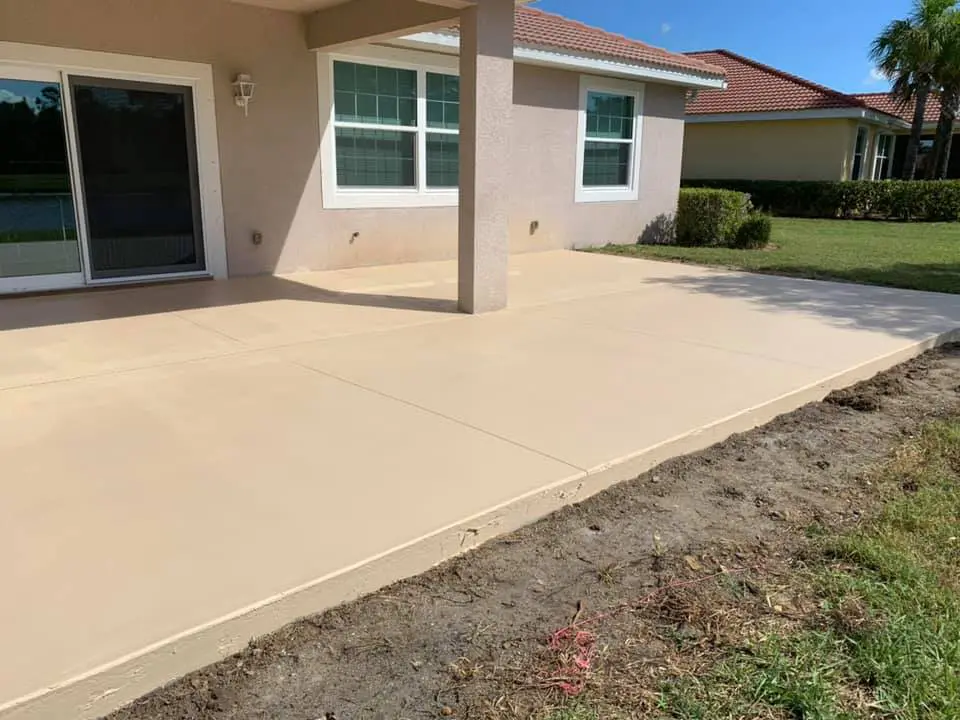
Searching for concrete patio installation near me brings up dozens of contractors, and that’s exactly where the problem starts. Not every result on your screen represents a licensed professional who knows how to handle Southwest Florida’s sandy soil, heavy rains, and brutal sun exposure. Picking the wrong one can mean cracked slabs, poor drainage, and thousands of dollars in repairs within just a few years.
At CHC Concrete, we’ve seen what happens when homeowners in Fort Myers, Cape Coral, Estero, and Bonita Springs hire based on price alone or skip the vetting process altogether. Concrete patios are long-term investments, and the contractor you choose determines whether yours holds up for decades or falls apart after a couple of hurricane seasons. We built our reputation on doing the work right, proper base preparation, correct reinforcement, and full cure times, so we know exactly what separates a quality installation from a shortcut-filled one.
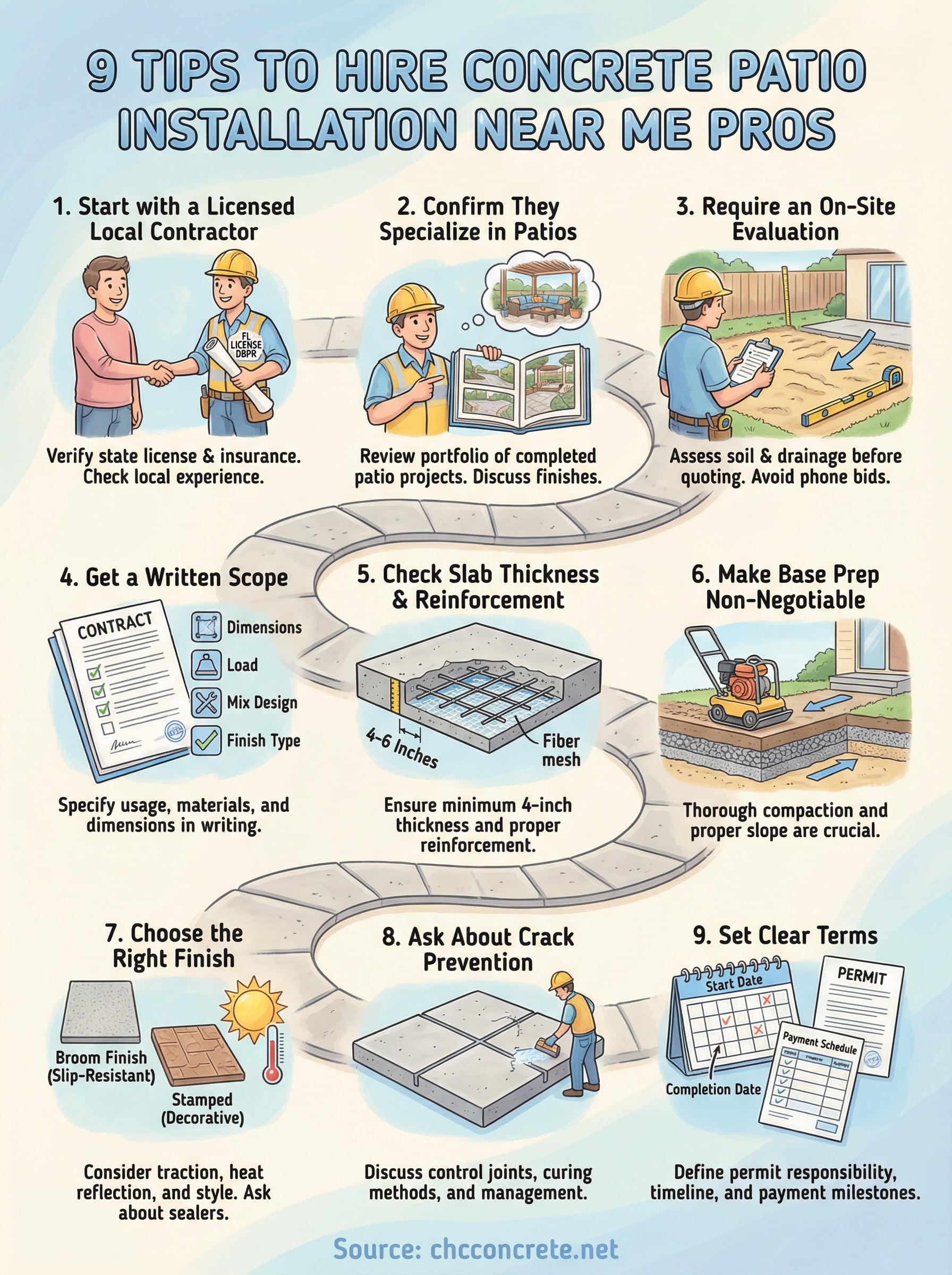
This article breaks down nine practical tips to help you evaluate, compare, and hire the right concrete patio contractor for your project. Whether you’re adding a new outdoor living space or replacing a slab that’s seen better days, these tips will help you ask the right questions and avoid the most common hiring mistakes. You’ll know what to look for in licensing, materials, project timelines, and more, before you sign anything.
1. Start with a licensed local concrete contractor
Licensing is the first filter you should apply when searching for concrete patio installation near me. In Florida, concrete contractors must hold a state-issued license through the Department of Business and Professional Regulation (DBPR), which you can verify online at no cost. Hiring unlicensed work puts you at legal and financial risk: no accountability, no insurance protection, and no guarantee the work meets local building codes.
What to look for
Check that the contractor holds an active Florida contractor’s license and carries both general liability insurance and workers’ compensation coverage. Local experience matters just as much. A contractor who has worked specifically in your county understands soil conditions, drainage patterns, and permitting requirements that are unique to Southwest Florida. Look for a physical business address, not just a cell number and a service truck with a logo on the side.
Questions to ask
Before you commit to anyone, ask these directly:
- What is your Florida contractor license number, and can I verify it through DBPR?
- Do you carry liability insurance and workers’ compensation, and will you provide current certificates?
- How many concrete patio projects have you completed in this city or county specifically?
- Are you familiar with local permitting requirements for residential patio work?
If a contractor hesitates or avoids answering any of these questions, treat that as a clear reason to keep looking.
Pricing and budget notes
A licensed and insured contractor will always cost more than an unlicensed one, and that gap is intentional. It reflects real costs: insurance premiums, licensing fees, and the overhead of running a legitimate operation. For a standard concrete patio in Southwest Florida, expect base pricing to start around $8 to $12 per square foot for a plain slab, with costs rising based on size, decorative finish, reinforcement requirements, and site conditions. Collecting multiple quotes from licensed contractors allows you to compare real proposals, not just numbers pulled from thin air.
Common mistakes to avoid
One of the most common mistakes homeowners make is accepting a low bid from a contractor who cannot produce a license number or current insurance certificates on request. Another is relying entirely on a neighbor’s referral without independently confirming the contractor’s license status through the DBPR website. A personal recommendation is a useful starting point, but it does not replace your own verification step. You should also avoid any contractor who provides a firm price entirely over the phone, since accurate patio pricing requires a physical site visit to assess your space, soil type, and existing drainage conditions before any number is put on paper.
2. Confirm they specialize in patios, not just any concrete
A contractor who pours driveways and culverts all week is not automatically qualified to install your patio. Patio work involves specific finishing techniques, drainage considerations, and decorative options that differ from other flatwork jobs. When you search for concrete patio installation near me, you want someone who regularly works on outdoor living surfaces, not a generalist who treats every pour the same way.
What to look for
Look for a contractor who can show you a portfolio of completed patio projects, preferably from jobs in Southwest Florida where soil and weather match your site. They should discuss surface finishes, control joint placement, and drainage slope without hesitation.
If a contractor cannot show you recent patio work they have completed, that gap is worth addressing before you move forward.
A patio specialist knows the slab must direct water away from your home’s foundation and builds that into the prep work from day one, not as an afterthought.
Questions to ask
Ask these before you commit:
- How many patios have you installed in the past 12 months?
- Can you show photos of comparable projects, including the finished surface?
- What finish options do you recommend for an outdoor patio in this region, and why?
- How do you handle slope and drainage in your patio designs?
Pricing and budget notes
Patio specialists may charge slightly more than general concrete contractors, but that difference reflects real expertise in surface quality and long-term durability. Decorative finishes such as stamped concrete or exposed aggregate add roughly $3 to $8 per square foot on top of base slab pricing.
Requesting itemized quotes makes it straightforward to compare exactly what each contractor delivers for the money.
Common mistakes to avoid
Avoid hiring based on a low price without verifying that patio work is a consistent part of the contractor’s business, not an occasional side job.
Many homeowners also skip asking for a portfolio, which is one of the fastest ways to confirm the contractor has real hands-on experience with the surface type you want installed.
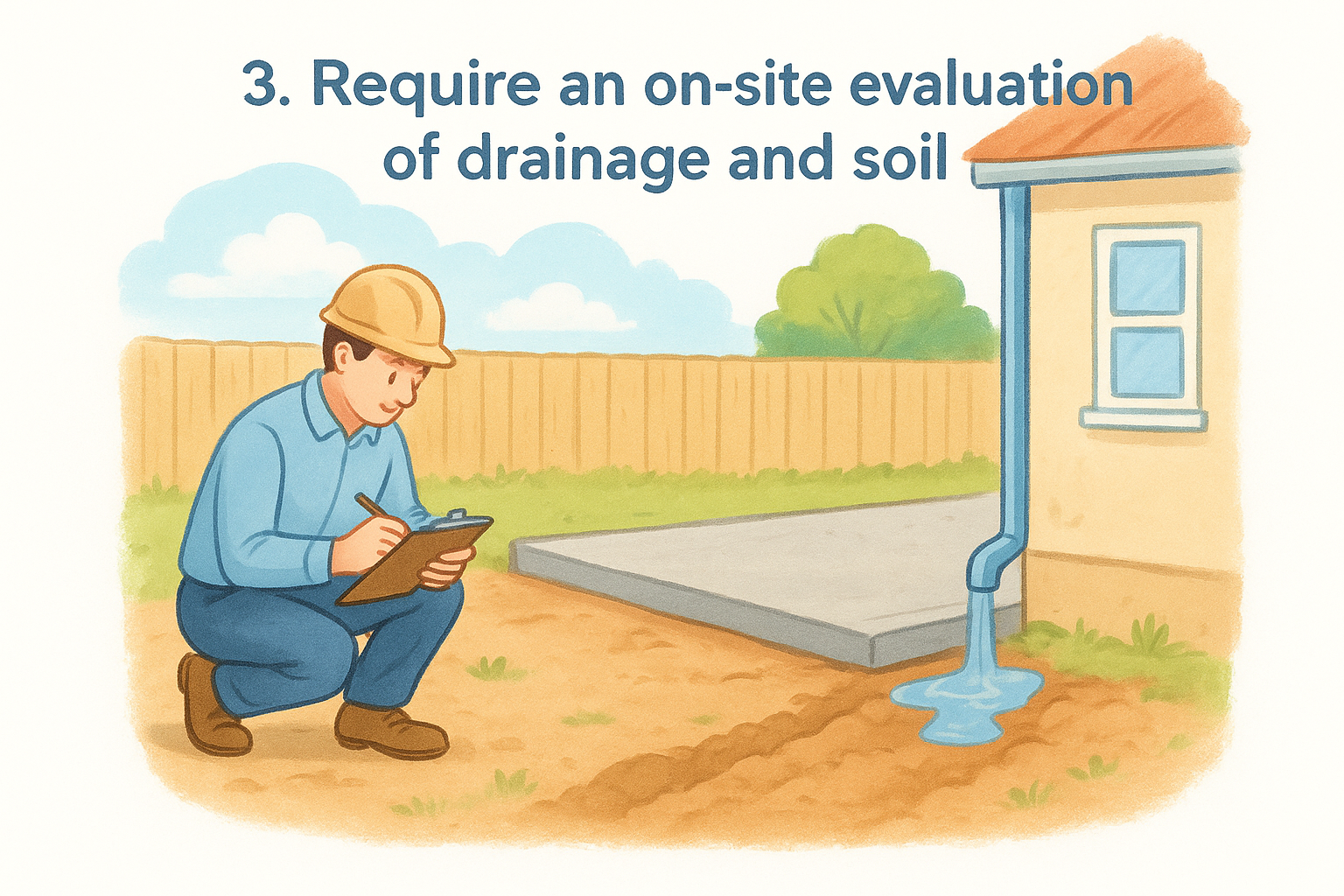
3. Require an on-site evaluation of drainage and soil
Any contractor worth hiring for concrete patio installation near me will insist on visiting your property before quoting. Southwest Florida soil is sandy, loose, and prone to shifting, particularly after heavy rainfall seasons. A proper on-site evaluation lets the contractor assess existing drainage patterns, measure the slope of your yard, and identify any soft spots or root intrusion that would compromise the slab before a single yard of concrete is poured.
What to look for
A thorough evaluation should include a visual inspection of soil stability and compaction across the full footprint of your planned patio. The contractor should also check for standing water patterns and proximity to your home’s foundation, both of which affect how the base will be prepared and graded.
If a contractor skips the site visit and quotes your project over the phone, that shortcut in the sales process usually signals shortcuts in the work itself.
Questions to ask
Use these questions to gauge whether a contractor takes site conditions seriously before committing to a number:
- Does your evaluation include soil compaction testing or a visual grading assessment?
- How will you slope the slab to direct water away from my home?
- What drainage problems have you encountered on similar sites nearby, and how did you address them?
Pricing and budget notes
Site conditions directly affect your final project cost. Contractors who discover poor compaction or drainage problems during the evaluation may add line items for additional base material or grading work. These additions are legitimate and should be itemized clearly in any written quote you receive so you understand exactly what you are paying for.
Common mistakes to avoid
Never accept a quote prepared without a site visit. Many homeowners also assume flat-looking yards drain well, but grade problems are often invisible to the naked eye without proper assessment. Skipping this step leads to pooling water, slab heaving, and expensive repairs that a proper evaluation would have prevented.
4. Get a written scope that matches how you will use it
A verbal agreement is not enough when you’re hiring for concrete patio installation near me. Your written scope should reflect exactly how you plan to use the space, whether that’s outdoor dining, heavy furniture, a grill station, or a hot tub. How you use your patio determines slab thickness, reinforcement, and finish requirements, and none of that can be inferred from a vague one-line quote.
What to look for
Your written scope should specify dimensions, intended load, concrete mix design, and surface finish type in clear language. If you plan to place heavy equipment or a spa on the slab, that information must appear in the document so the contractor accounts for it in the structural design and base preparation. A detailed scope protects you if the finished product does not match what you discussed during the estimate.
Questions to ask
Before signing, confirm the scope captures your specific situation by asking these directly:
- Does this scope account for the specific loads and furniture I described?
- What concrete mix and reinforcement does the scope specify for my use case?
- How will changes to the scope be handled, and will they be documented in writing?
Pricing and budget notes
A scope written around your actual usage prevents underbidding and costly change orders after work begins. Contractors who write vague scopes often add charges mid-project for items they should have included upfront. Require line-item pricing so you can see exactly what each component costs before the job starts.
If a contractor resists putting specific details in writing, that signals they are leaving room to cut corners later.
Common mistakes to avoid
Many homeowners accept a single-line written quote that says only “install concrete patio.” That document gives you no protection if the contractor pours the wrong thickness or skips reinforcement. Make sure every agreed detail, from slab depth to finish type, appears in the written scope before you sign.
5. Check slab thickness and reinforcement details
Slab thickness and reinforcement are two of the most consequential decisions in any concrete patio installation near me project, and they are also two of the easiest areas for contractors to cut without you noticing. A slab poured too thin or without proper steel will crack under load, shift with soil movement, and fail years before it should.
What to look for
For a standard residential patio, 4 inches is the minimum acceptable thickness, and 5 to 6 inches is appropriate if you plan to place a hot tub, park a vehicle along the edge, or position heavy outdoor equipment. Your contractor should also specify reinforcement in the form of rebar or fiber mesh depending on load requirements and soil conditions. Rebar provides structural tensile strength, while fiber mesh adds crack resistance throughout the slab body.
If a contractor cannot explain their reinforcement approach in plain terms before the pour, that is a gap worth addressing before you approve anything.
Questions to ask
Ask your contractor these directly before they finalize the scope:
- What slab thickness do you recommend for my specific use case and soil type?
- Will you use rebar, fiber mesh, or a combination, and what spacing will the rebar follow?
- How do you determine reinforcement requirements based on load and site conditions?
Pricing and budget notes
Thicker slabs and proper reinforcement add material and labor costs, but skipping them costs far more in repairs over time. Rebar-reinforced pours typically add $1 to $2 per square foot over a basic fiber mesh installation. That difference is small compared to the cost of saw-cutting and replacing a failed slab prematurely.
Common mistakes to avoid
Many homeowners accept a quote without ever seeing thickness or reinforcement specified in writing. Another common error is assuming all concrete patios are built the same way. Your contractor should be able to explain their reinforcement rationale clearly based on your site and intended use, not offer a one-size-fits-all answer.
6. Make base prep and grading non-negotiable
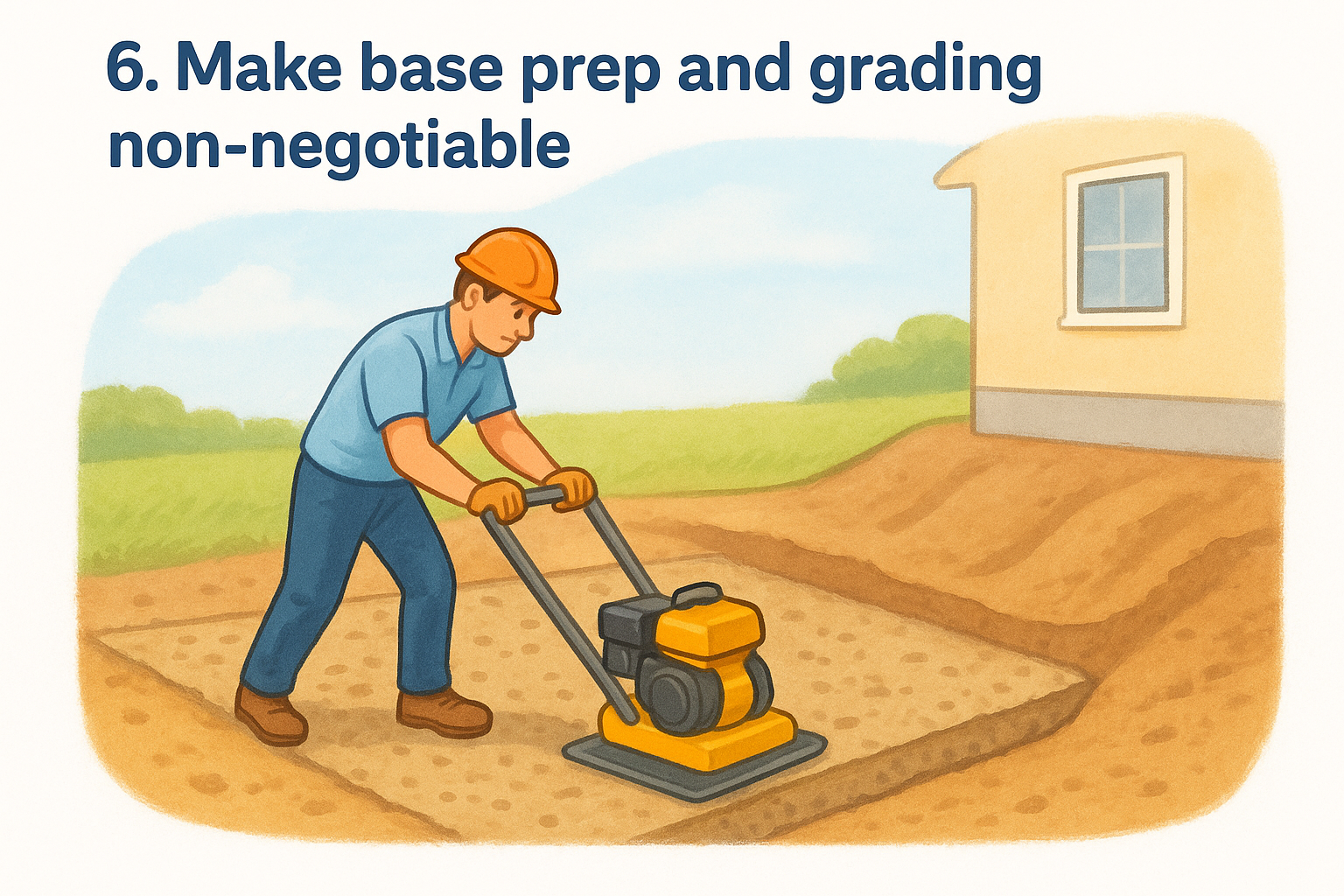
Base prep is the foundation that determines whether your concrete patio holds up or fails early. In Southwest Florida, sandy, unstable soil requires thorough compaction and proper grading before any concrete touches the ground. Contractors who rush or skip this step produce slabs that crack, sink, and pond water within just a few years of installation.
What to look for
Your contractor should compact the base material in multiple layers using mechanical equipment, not just a hand tamper. They should also establish a deliberate slope of at least 1/8 inch per foot away from your home to ensure rainwater drains off the slab surface rather than pooling against your foundation. For most concrete patio installation near me projects in Southwest Florida, crushed stone or compacted fill over native sandy soil is standard practice.
Skipping proper base compaction is the single most common reason residential patios in this region crack or settle prematurely.
Questions to ask
Ask your contractor these questions directly before approving anything:
- What base material and compaction method will you use under the slab?
- How many compaction passes do you make before pouring?
- What slope will you build into the finished slab to handle drainage?
Pricing and budget notes
Base preparation adds cost but represents the most critical line item in your project. Expect compaction work and fill material to account for $1 to $3 per square foot of your overall quote. Contractors who offer unusually low bids often skip base work entirely, which removes a real cost from their estimate but transfers the risk directly to you.
Common mistakes to avoid
Homeowners frequently focus on the visible surface finish and ignore what happens below grade. Never approve a quote that omits base preparation details. Accepting vague language like “site prep included” without specific materials and methods listed gives the contractor room to cut corners before a single yard of concrete is poured.
7. Choose a finish that fits traction, heat, and style
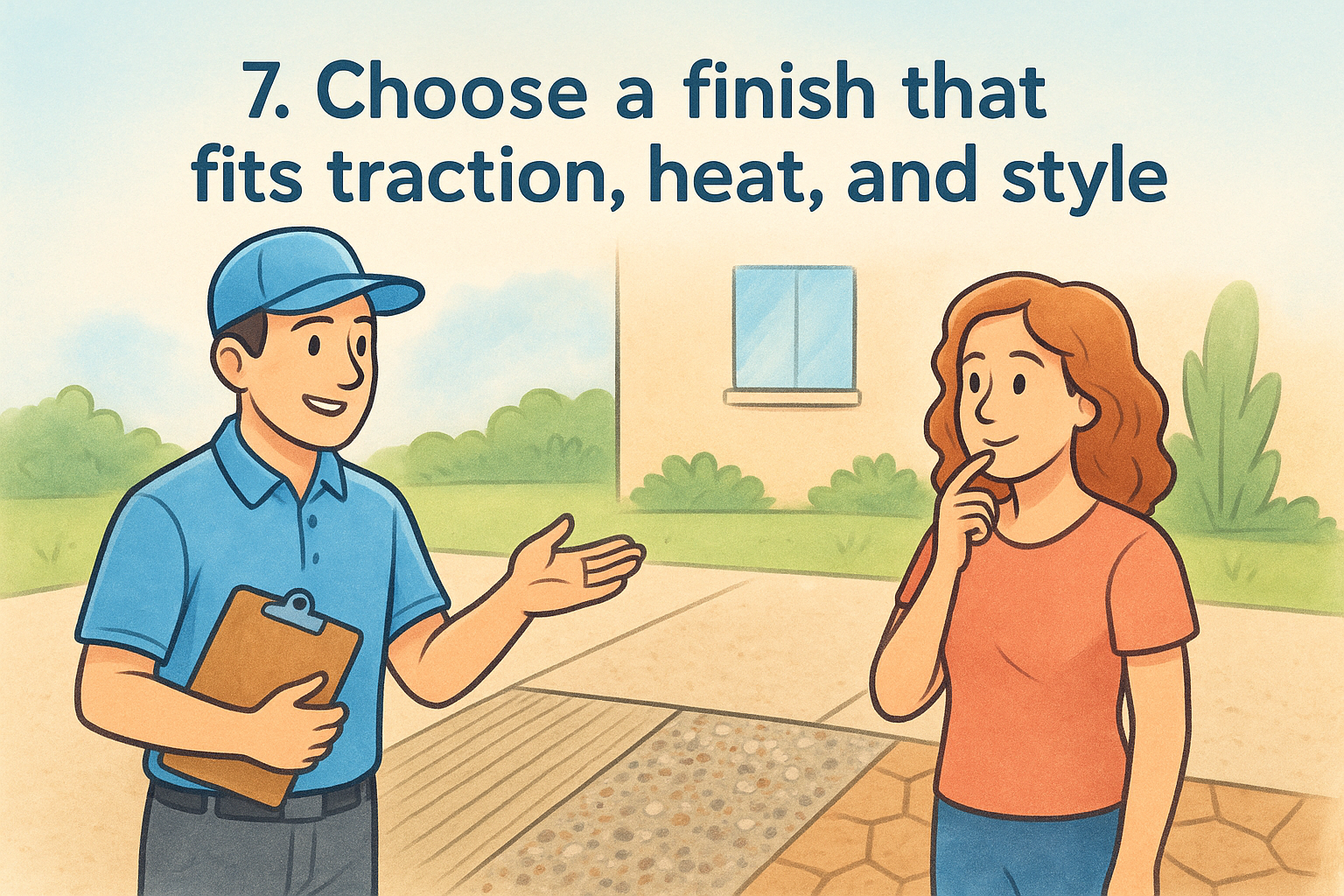
The surface finish on your patio affects safety, comfort, and long-term durability just as much as the structural decisions beneath it. In Southwest Florida, you need a finish that handles intense UV exposure, barefoot traffic, and the kind of heat that makes a dark slab nearly untouchable in July. When evaluating concrete patio installation near me options, make sure the contractor can match a finish to your actual conditions, not just your aesthetic preferences.
What to look for
Look for a contractor who offers slip-resistant texture options such as broom finish, exposed aggregate, or stamped patterns with non-skid sealers. Lighter-colored finishes reflect more heat than dark ones, which matters when your patio gets direct afternoon sun for hours each day. Your contractor should also recommend a UV-resistant sealer to protect the surface from fading and surface degradation over time.
The finish you choose on day one determines how safe, comfortable, and low-maintenance your patio will be five summers from now.
Questions to ask
Ask the contractor these directly before finalizing the scope:
- What finish options do you recommend for a patio in this sun exposure and climate?
- How does each option perform in terms of heat retention and slip resistance when wet?
- What sealer do you use, and how often does it need to be reapplied?
Pricing and budget notes
Basic broom finishes are the most affordable, while stamped and stained concrete surfaces add $3 to $8 per square foot to your base cost. Decorative finishes require more labor and specialized materials, so request itemized pricing for each finish type you are considering so you can compare the real cost difference before deciding.
Common mistakes to avoid
Avoid choosing a finish based only on photos from a catalog. Dark-colored finishes absorb significantly more heat, which becomes a real problem on a patio you intend to use barefoot in summer. Many homeowners also skip asking about sealer requirements, which leaves the surface vulnerable to staining and weather damage far sooner than a properly sealed slab would show any wear.
8. Ask how they prevent and manage cracking
Cracking is the most visible sign that a concrete patio installation near me went wrong, but it usually starts long before the surface shows any damage. Control joints, proper curing, and reinforcement all work together to manage where and how concrete moves as it settles and responds to temperature changes. A contractor who cannot explain their crack prevention strategy in plain terms is likely not thinking carefully enough about long-term performance.
What to look for
Look for a contractor who places control joints at planned intervals to guide where the concrete relieves stress as it cures and contracts. In Southwest Florida, the combination of intense heat, heavy rain, and sandy soil movement creates conditions that accelerate cracking if the slab is not built and cured correctly. Your contractor should also describe their curing method clearly, whether that involves wet curing, curing compounds, or both, since proper moisture retention during the curing window directly affects slab integrity.
Questions to ask
Ask your contractor these directly before approving the scope:
- Where and how often will you place control joints across the slab?
- What curing method do you use, and for how long after the pour?
- How do you adjust your approach for Southwest Florida’s heat and shifting soil?
If a contractor says cracking is just unavoidable without offering any specific prevention steps, that answer should concern you.
Pricing and budget notes
Control joint placement and proper curing add minimal cost but protect your slab significantly over time. Budget a small allowance for curing compounds or protective cover materials if your contractor includes them as a line item, since these materials are worth every dollar.
Common mistakes to avoid
Many homeowners skip asking about crack prevention entirely, assuming all contractors handle it the same way. Never accept a vague answer about cracking as “just part of the process” without pushing for specifics on joint spacing, curing time, and reinforcement details before any work begins.
9. Set clear terms for permits, schedule, and payments
Before any concrete patio installation near me project begins, you need a written contract that covers three things explicitly: permit responsibility, project timeline, and payment structure. A handshake agreement leaves you exposed if the job drags on, fees surface unexpectedly, or the contractor disappears after the first deposit clears.
What to look for
Your contract should name who pulls the permits, list the expected start and completion dates, and break the payment schedule into clearly defined milestones tied to work completion. In Florida, certain patio projects require a building permit depending on size and municipality. A reputable contractor handles this process and pulls the permit in their name, not yours.
If a contractor asks you to pull the permits yourself, that is a sign they may not be properly licensed to do so.
Questions to ask
Ask your contractor these directly before you sign anything:
- Who is responsible for pulling permits, and will that be completed before work starts?
- What is the projected start date and completion window for my project?
- How is the payment schedule structured, and what milestone triggers each payment?
Pricing and budget notes
Never pay the full project cost upfront. A standard payment structure divides costs across project phases: a deposit at signing, a payment at the midpoint of work, and a final payment upon completion and your approval. This structure keeps the contractor accountable and gives you leverage if something needs correction before you sign off.
Common mistakes to avoid
Homeowners often sign contracts with vague language like “work will be completed in a timely manner” instead of requiring specific dates in writing. Skipping permit verification is equally risky, since unpermitted work can complicate your home sale and expose you to fines you had no part in creating.
Next steps
These nine tips give you a reliable framework for evaluating any concrete patio installation near me candidate before you commit money or time to the project. You now know what to verify in terms of licensing, base preparation, reinforcement, and contract terms, so you can spot the difference between a contractor who builds patios to last and one who cuts corners where it counts.
If your project is in Fort Myers, Cape Coral, Estero, or Bonita Springs, CHC Concrete works specifically in Southwest Florida’s soil and climate conditions and brings licensed, insured expertise to every patio installation we handle. We offer free on-site evaluations so you can see our process in person before signing anything. No pressure, no vague phone quotes, just a straight conversation about what your project actually requires. Reach out to CHC Concrete to schedule your free estimate and get your project started on the right foundation.