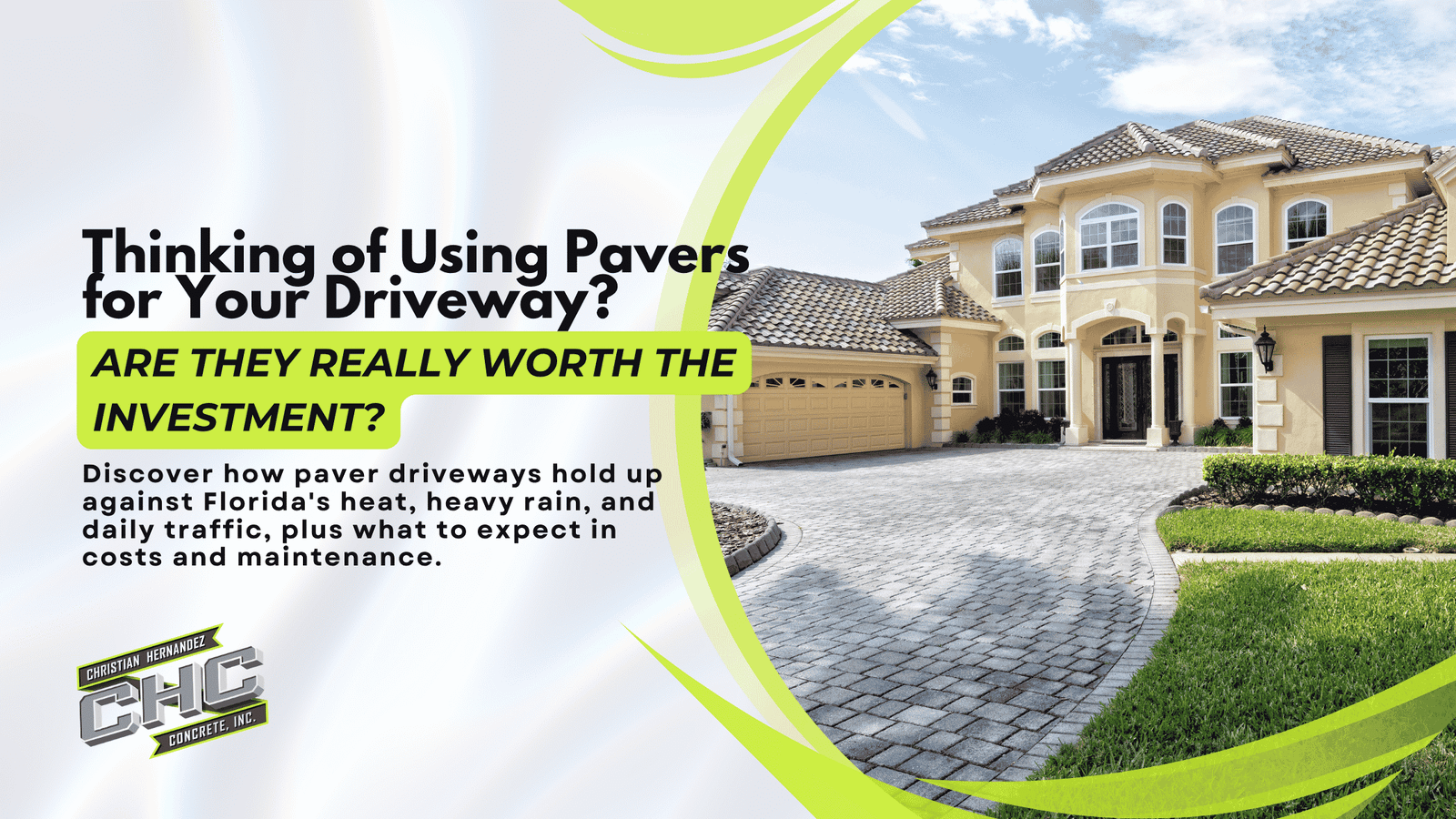
Key Takeaways:
- Pavers offer strong aesthetic appeal and flexibility, but Florida’s climate, soil conditions, and long-term maintenance demands make them a more complex choice than many homeowners expect.
- Concrete driveways often outperform pavers in Southwest Florida due to their durability, lower maintenance burden, and resistance to the region’s heat, moisture, and shifting soils.
- Understanding the trade-offs between pavers and poured concrete is essential before committing to a driveway installation in Fort Myers, Cape Coral, Naples, or the broader SWFL area.
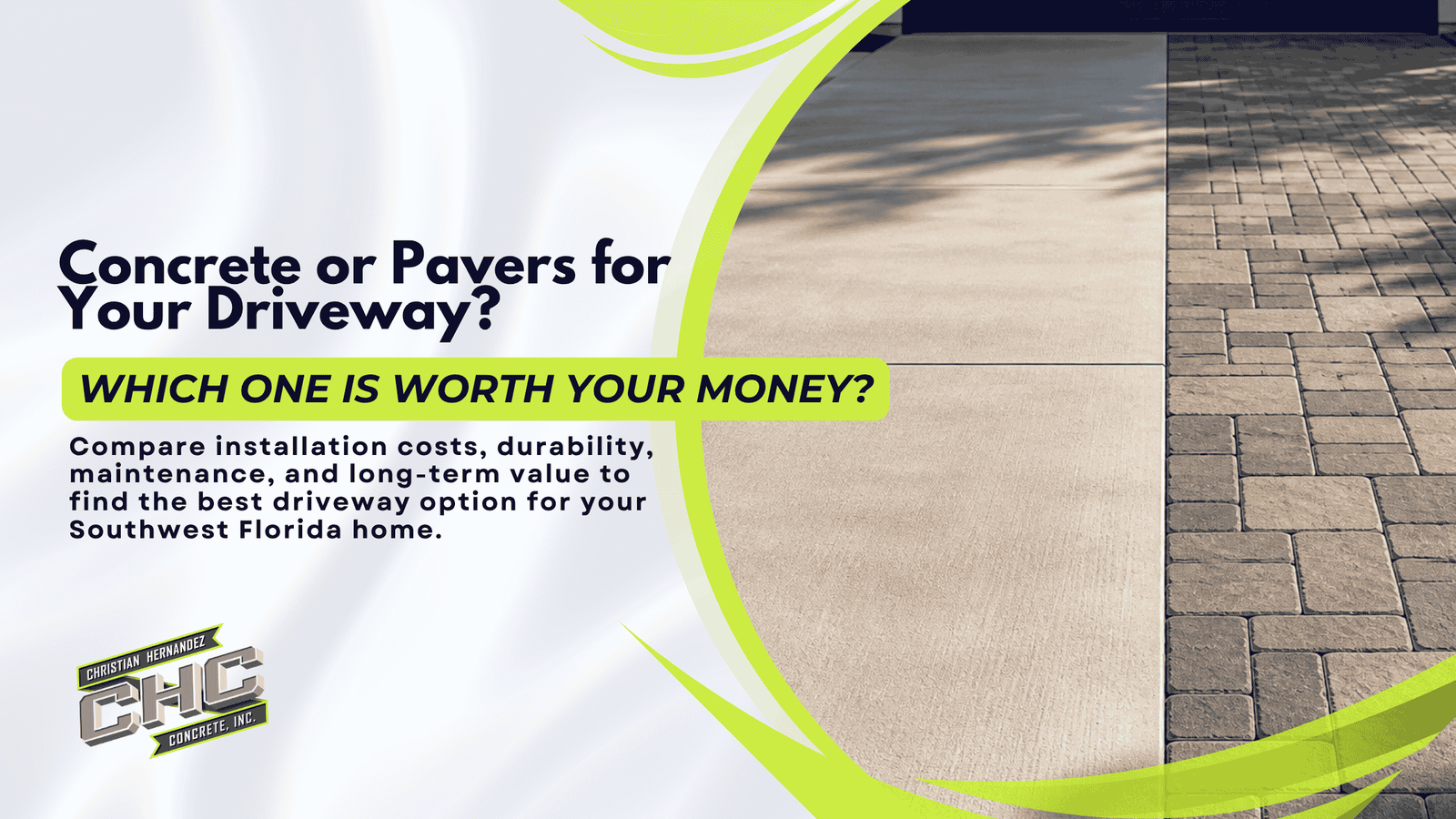
Driveway decisions in Florida carry more weight than in most other states. The combination of intense UV exposure, heavy seasonal rainfall, high humidity, and sandy or expansive soil creates conditions that can break down certain materials faster than homeowners anticipate. Pavers are frequently recommended by landscape designers and home improvement shows as a stylish, versatile option — and they do have real advantages. But whether they’re the right choice for a Florida driveway depends on a set of factors that often get glossed over in the marketing.
This article breaks down what pavers actually deliver in a Florida climate, where they fall short, and how they compare to concrete — the material that has quietly remained the workhorse of Southwest Florida driveways for decades.
What Are Pavers, Exactly?
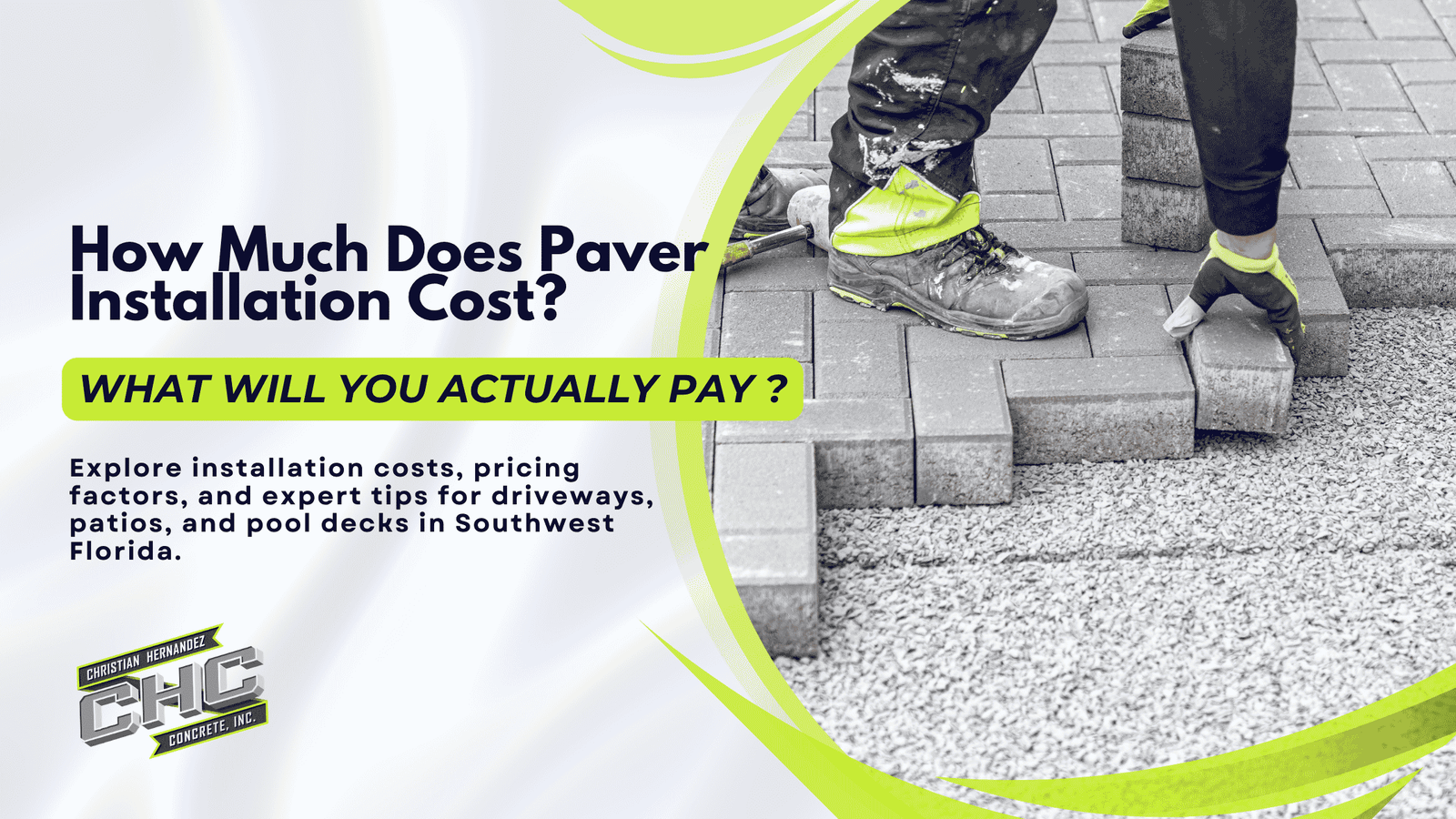
Pavers are individual units — typically made from concrete, brick, or natural stone — that are set into a prepared base layer rather than poured as a continuous slab. The most common type used in Florida residential driveways is interlocking concrete pavers (ICP), though clay brick and travertine are also popular in higher-end applications.
The appeal is obvious. Pavers come in dozens of shapes, colors, and patterns. They can be customized to match a home’s architectural style, and because they’re modular, a damaged section can theoretically be replaced without touching the rest of the surface.
That flexibility is real. So are the complications.
The Case for Pavers in Florida
Pavers aren’t a bad choice across the board. In the right application and with proper installation, they perform well and add genuine curb appeal. Here’s where they hold up:
Aesthetic Variety
No other driveway material gives homeowners as many visual options. Whether a property calls for a herringbone brick pattern, a travertine tile look, or a custom geometric design, pavers can deliver it. In communities where HOA guidelines demand a certain look, pavers often satisfy requirements that plain concrete cannot.
Joint Flexibility
Florida soils expand and contract with moisture changes. Because pavers are individual units rather than a continuous slab, they have some capacity to shift slightly without cracking. This can be an advantage in areas with moderately unstable soil — the joints absorb minor movement that would crack a monolithic surface.
Repairability
If a single paver cracks or settles, it can be pulled and replaced. That’s a genuine benefit in theory. In practice, finding a perfect color match years later is harder than it sounds, and the labor cost of pulling, releveling, and resetting pavers adds up quickly.
Drainage Options
Permeable paver systems allow water to filter through the joints into a gravel base below. In flood-prone areas of Southwest Florida, this can help with surface water management. That said, permeable systems require ongoing maintenance to prevent joint material from washing out or clogging.
Where Pavers Struggle in Southwest Florida
This is where the conversation shifts. Florida’s specific environmental conditions create challenges for paver driveways that aren’t always discussed upfront.
Joint Erosion and Weed Intrusion
The sand or polymeric sand used to fill paver joints is constantly under assault in Florida. Heavy rain washes it out. Roots from nearby trees and vegetation push through. Weeds and grass find their way into the gaps persistently. Homeowners who choose pavers should expect to resand joints periodically and apply herbicide treatments on a regular basis — this is not a one-time installation and walk away situation.
Heat and UV Fading
Florida receives more annual sunshine than almost any other state. Concrete pavers can fade and discolor over time under sustained UV exposure. Sealing helps, but sealer needs to be reapplied every two to three years to maintain color protection and stain resistance. Travertine holds its color better but comes at a significantly higher price point.
Shifting and Settling
Florida’s sandy soils are notoriously prone to shifting, especially in coastal areas like Cape Coral and Naples. A paver driveway is only as stable as the base beneath it. If that base isn’t properly compacted and prepared, individual pavers will settle unevenly over time, creating trip hazards, drainage problems, and a surface that looks piecemeal. Releveling a settled section isn’t catastrophic, but it’s not cheap either.
Installation Cost
Pavers consistently run higher than poured concrete on a per-square-foot basis. When factoring in materials, the prepared base, edge restraints, and labor, a paver driveway in Southwest Florida can cost anywhere from 30 to 60 percent more than a comparable concrete installation. For homeowners on a fixed budget, that premium is a real consideration.
Long-Term Maintenance Burden
Taken individually, paver maintenance tasks seem minor. Added together — resealing every few years, resanding joints, pulling weeds, addressing settled sections, power washing — the cumulative time and cost commitment is higher than most people expect at the point of purchase.
How Concrete Compares for Florida Driveways
Poured concrete is not glamorous. It doesn’t come with the design catalog that pavers do. But in Southwest Florida’s demanding climate, it consistently delivers performance that paver driveways can struggle to match.
A properly installed concrete driveway creates a monolithic surface with no joints for weeds to infiltrate or sand to wash out of. It handles the weight of vehicles without individual units shifting. It holds up under UV exposure without the same level of fading, and when it’s sealed, it’s significantly easier to maintain than a jointed paver surface.
The common objection to concrete is that it cracks. That’s fair — no material is impervious. But modern concrete driveway installation includes control joints that guide cracking in predictable, manageable ways. A skilled contractor accounts for soil conditions, reinforcement, and proper curing to minimize cracking risk. And when cracking does occur, concrete repair options have improved significantly.
For homeowners exploring paver installation as one part of a broader hardscaping plan — perhaps combining a stamped concrete driveway with paver accents along a walkway or border — that hybrid approach can capture the best of both materials without the full maintenance burden of an all-paver surface.
A Side-by-Side Comparison
| Factor | Pavers | Poured Concrete |
|---|---|---|
| Upfront Cost | Higher (30–60% more) | Lower |
| Aesthetic Options | Extensive | Moderate (stamped options available) |
| Joint Maintenance | Ongoing (resanding, weeding) | None |
| UV/Fade Resistance | Moderate (sealing required) | Good |
| Settling Risk in Sandy Soil | Higher | Lower with proper base prep |
| Repairability | High (individual units) | Moderate (patching, resurfacing) |
| Lifespan (well-installed) | 20–30 years | 25–40 years |
| Sealing Frequency | Every 2–3 years | Every 3–5 years |
| Drainage Options | Permeable systems available | Surface slope drainage standard |
Florida-Specific Soil and Climate Considerations
Southwest Florida is not a neutral testing ground for hardscape materials. Fort Myers, Cape Coral, Bonita Springs, and Estero all sit on sandy, sometimes fill-based soils that behave differently than the clay-heavy ground common in other parts of the country.
Moisture fluctuation is extreme. Dry season in SWFL can run several months, followed by a rainy season that dumps over 50 inches of rain annually in some areas. This cycle of drying and saturation causes soil to move. Any driveway material needs a properly prepared base to handle that movement, and the installation quality matters far more in Florida than in more stable climates.
The other factor is salt air. Coastal communities near Naples and Cape Coral expose hardscape materials to airborne salt, which can accelerate surface degradation in both concrete and certain paver types. Proper sealing is essential in these areas regardless of which material is chosen.
What Homeowners Should Ask Before Deciding
Before committing to either pavers or concrete for a Florida driveway, homeowners should walk through a few critical questions:
- What is the soil condition and drainage history of the property?
- Is the driveway on a coastal lot with salt air exposure?
- What is the realistic long-term maintenance budget and time commitment?
- Is the goal primarily aesthetic, functional, or both?
- Are there HOA requirements that dictate material type or appearance?
- What are comparable homes in the neighborhood using?
The answers to these questions often move the needle significantly. Many homeowners who come in asking about pavers leave with a clearer picture of why concrete — particularly a stamped or decorative concrete option — delivers comparable aesthetics with a lower lifetime cost and maintenance load.
CHC Concrete has worked with Southwest Florida homeowners for over 35 years across communities including Fort Myers, Cape Coral, Naples, Bonita Springs, Estero, and North Fort Myers. With more than 150 five-star Google reviews, the company’s experience with local soil conditions, climate factors, and homeowner priorities gives them a practical perspective that goes beyond any single material preference. See what past clients have experienced on the CHC Concrete testimonials page.
Are Pavers Worth the Investment in SWFL?
The honest answer: it depends on what a homeowner is optimizing for.
If the goal is maximum curb appeal and the homeowner is prepared to maintain the surface properly — resealing, resanding joints, managing weeds, and budgeting for occasional releveling — pavers can deliver a distinctive, high-end look that poured concrete typically doesn’t match without decorative finishing.
If the goal is a durable, low-maintenance, long-lasting surface that holds up to Florida’s climate demands without ongoing intervention, concrete has a strong argument that is hard to dismiss. The lifetime cost difference, when maintenance is factored in, often makes concrete the more economical choice over a 20 to 30 year horizon.
The middle path — combining poured or stamped concrete as the primary driveway surface with paver accents, borders, or walkway transitions — is worth exploring seriously. It captures the visual interest of pavers in lower-traffic, easier-to-maintain applications while keeping the main driving surface simple and durable.
For homeowners in Southwest Florida ready to move forward, getting a professional assessment of their property’s soil conditions, drainage, and design goals is the most valuable first step. That conversation changes the decision significantly more often than any amount of online research.
Frequently Asked Questions
How long do pavers last in Florida’s climate?
Well-installed concrete pavers in Florida can last 20 to 30 years, though the actual lifespan depends heavily on base preparation quality, UV exposure, salt air proximity, and maintenance consistency. Without regular sealing and joint maintenance, deterioration accelerates.
Are pavers more expensive than concrete driveways in Southwest Florida?
Yes, typically by a significant margin. Paver installation in SWFL generally runs 30 to 60 percent higher than poured concrete on a per-square-foot basis when factoring in materials, base preparation, edge restraints, and labor. Long-term maintenance costs also favor concrete.
Do pavers crack in Florida heat?
Individual concrete pavers are less prone to thermal cracking than a monolithic slab because the joints between units absorb some expansion. However, UV fading is a real concern, and the joint sand or polymeric filler can degrade under sustained heat and heavy rain cycles.
What is the best driveway material for coastal Florida communities?
For coastal areas with salt air exposure — like Naples, Cape Coral, and Estero — both pavers and concrete require sealing to resist surface degradation. Concrete generally requires less ongoing joint maintenance, making it a practical choice in coastal Southwest Florida environments. Proper sealing and periodic reapplication matter regardless of the material chosen.
Can CHC Concrete install or advise on paver driveways in Southwest Florida?
CHC Concrete serves Fort Myers, Cape Coral, Naples, Bonita Springs, Estero, North Fort Myers, and surrounding SWFL communities with 35+ years of local experience. Homeowners can contact CHC Concrete directly to discuss their specific driveway project, get a professional assessment of their property, and explore which material makes the most sense for their situation.
Conclusion
Pavers are a genuinely attractive driveway option, and in the right context, they perform well. But the Florida environment — particularly in Southwest Florida — adds variables that tip the balance more than most homeowners realize before installation. Joint erosion, soil shifting, UV fading, and ongoing maintenance costs are not theoretical concerns here; they’re documented realities that experienced local contractors deal with every season.
Concrete has earned its dominant position in Florida driveways through decades of proven performance under conditions that test every material. That doesn’t mean pavers are the wrong choice for every homeowner, but it does mean the decision deserves a candid, locally-informed conversation — not just a Pinterest board.
Ready to explore driveway options for your Southwest Florida home? Contact CHC Concrete today to speak with an experienced local contractor who understands SWFL conditions, soil challenges, and what actually holds up over the long haul.