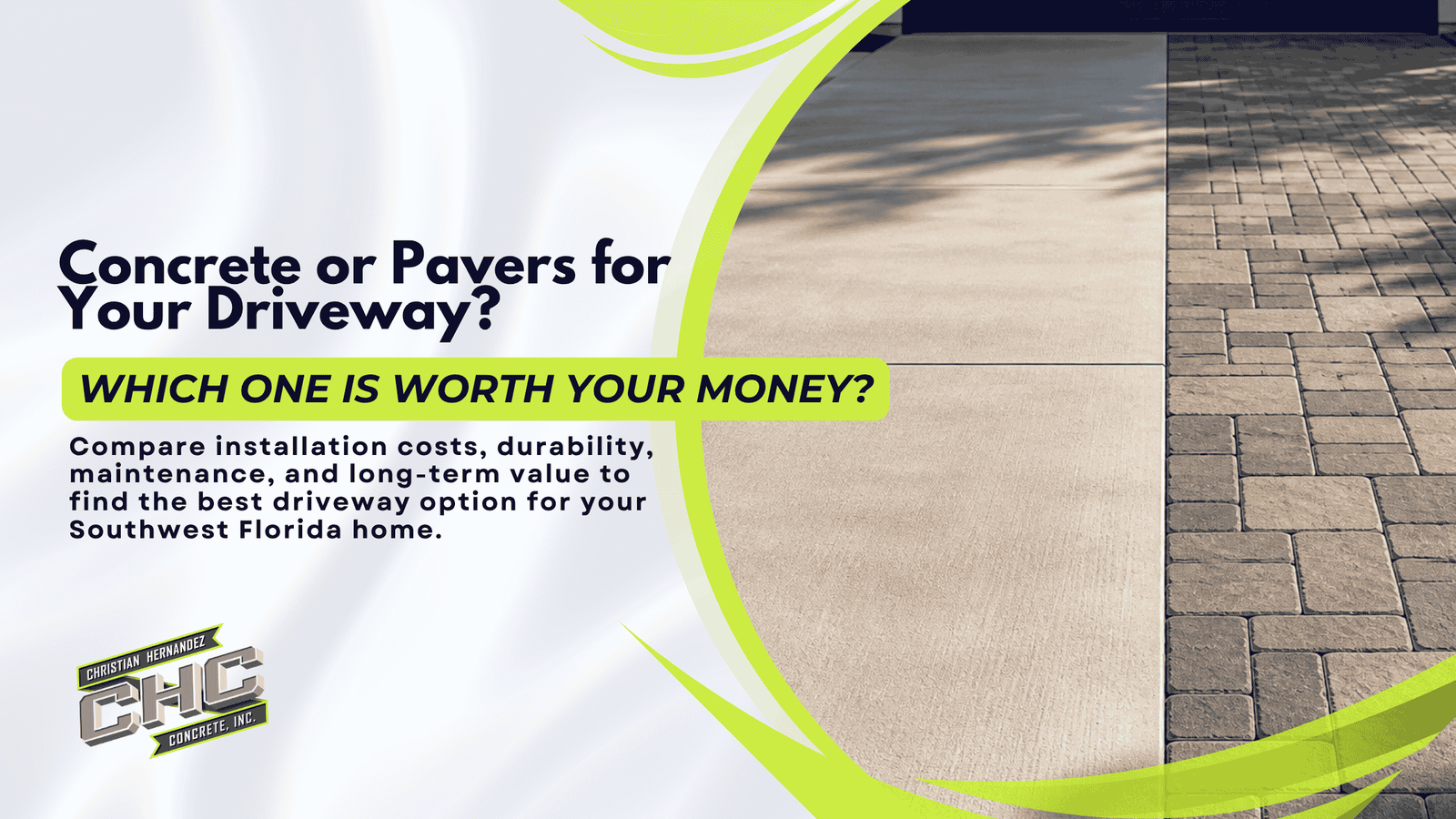
Key Takeaways:
- Florida’s heat, humidity, and heavy rainfall create unique demands that make material choice critical for driveway longevity.
- Concrete driveways generally offer lower upfront costs, easier maintenance, and superior structural performance in Southwest Florida’s climate.
- Pavers provide aesthetic flexibility and easier spot repair but come with higher installation costs and long-term upkeep challenges in sandy Florida soil.
Choosing a driveway material in Florida is not the same decision it would be in Ohio or Colorado. The subtropical climate, the sandy limestone-rich soil, the brutal UV exposure, and the annual hurricane season all factor into how a driveway performs over time. For homeowners in Fort Myers, Cape Coral, Naples, and surrounding Southwest Florida communities, the choice typically comes down to two options: poured concrete or interlocking pavers.
Both materials have genuine merit. Both have real drawbacks. But when you evaluate them honestly against the specific conditions of SWFL living, a clearer picture emerges.
Understanding the Florida Climate Factor
Before comparing materials on cost or appearance, it helps to understand what any driveway in Southwest Florida is actually up against.
The region sees average annual rainfall exceeding 55 inches, with the majority concentrated between June and September. That water has to go somewhere, and when a driveway impedes proper drainage, problems compound fast. Ground temperatures in SWFL regularly push 90°F or higher through the summer months, which affects how materials expand, contract, and cure. The soil composition across much of Lee and Collier counties is sandy and can shift, particularly after heavy rain events or following periods of drought.
Add direct sun exposure for 8–10 hours a day, and you have a testing environment that separates good installation from poor installation in a matter of a few years.
What Is a Concrete Driveway?
A concrete driveway is poured as a continuous slab, typically reinforced with rebar or wire mesh. In Florida, standard residential driveways are usually 4 inches thick, though high-load areas like near the garage apron often benefit from 5–6 inch thickness.
Concrete is mixed with a specific water-to-cement ratio and placed in forms, then finished, cured, and sealed. The end product is a solid, monolithic surface. Control joints — saw-cut lines placed intentionally in the slab — allow for natural expansion and contraction without random cracking.
Done correctly, a concrete driveway in Southwest Florida can last 25–30 years or longer with minimal maintenance.
What Are Paver Driveways?
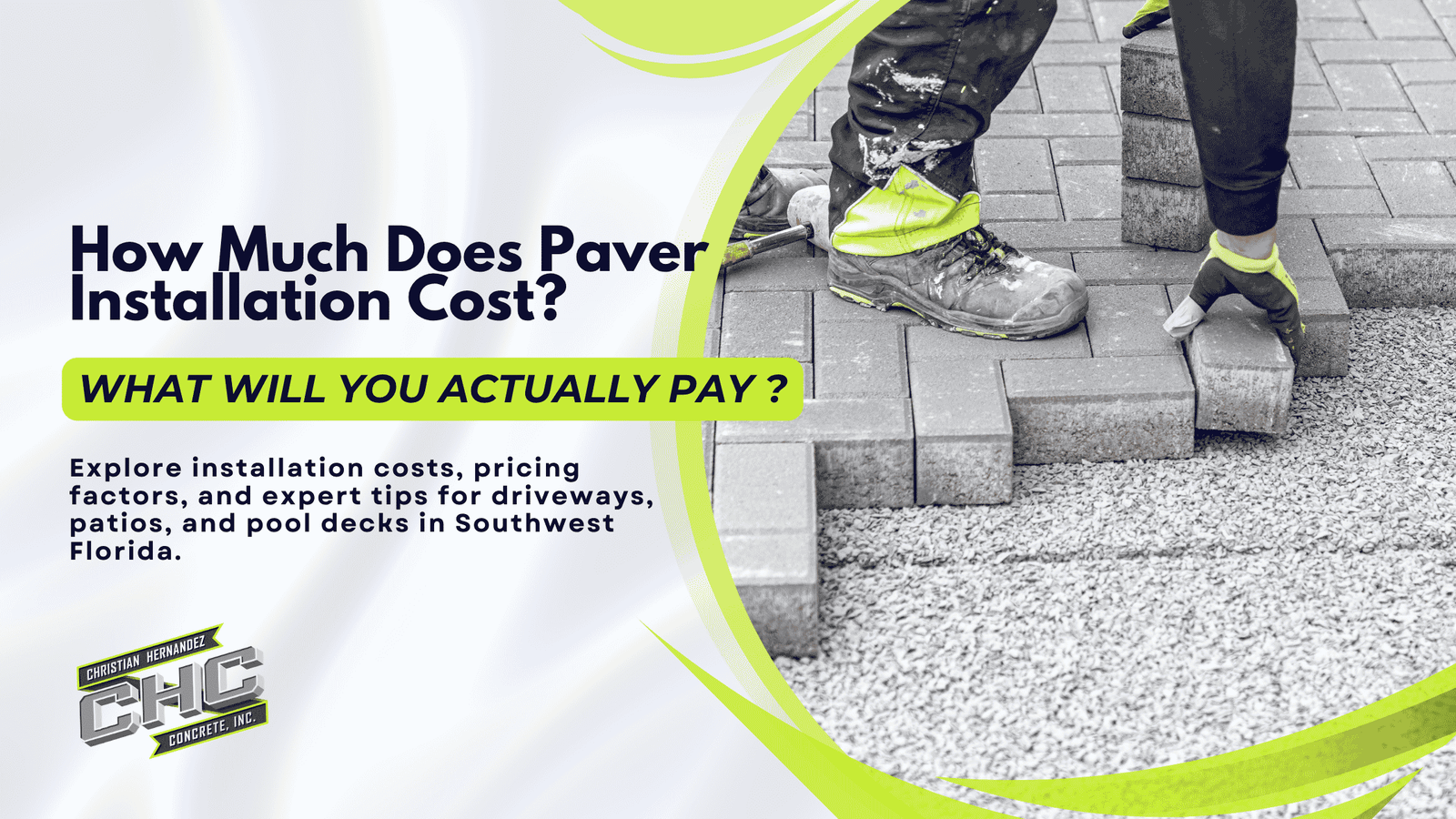
Pavers are individual units — typically made from concrete, brick, or natural stone — installed in a pattern over a compacted base of crushed gravel and sand. Each paver interlocks with its neighbors to form the finished surface.
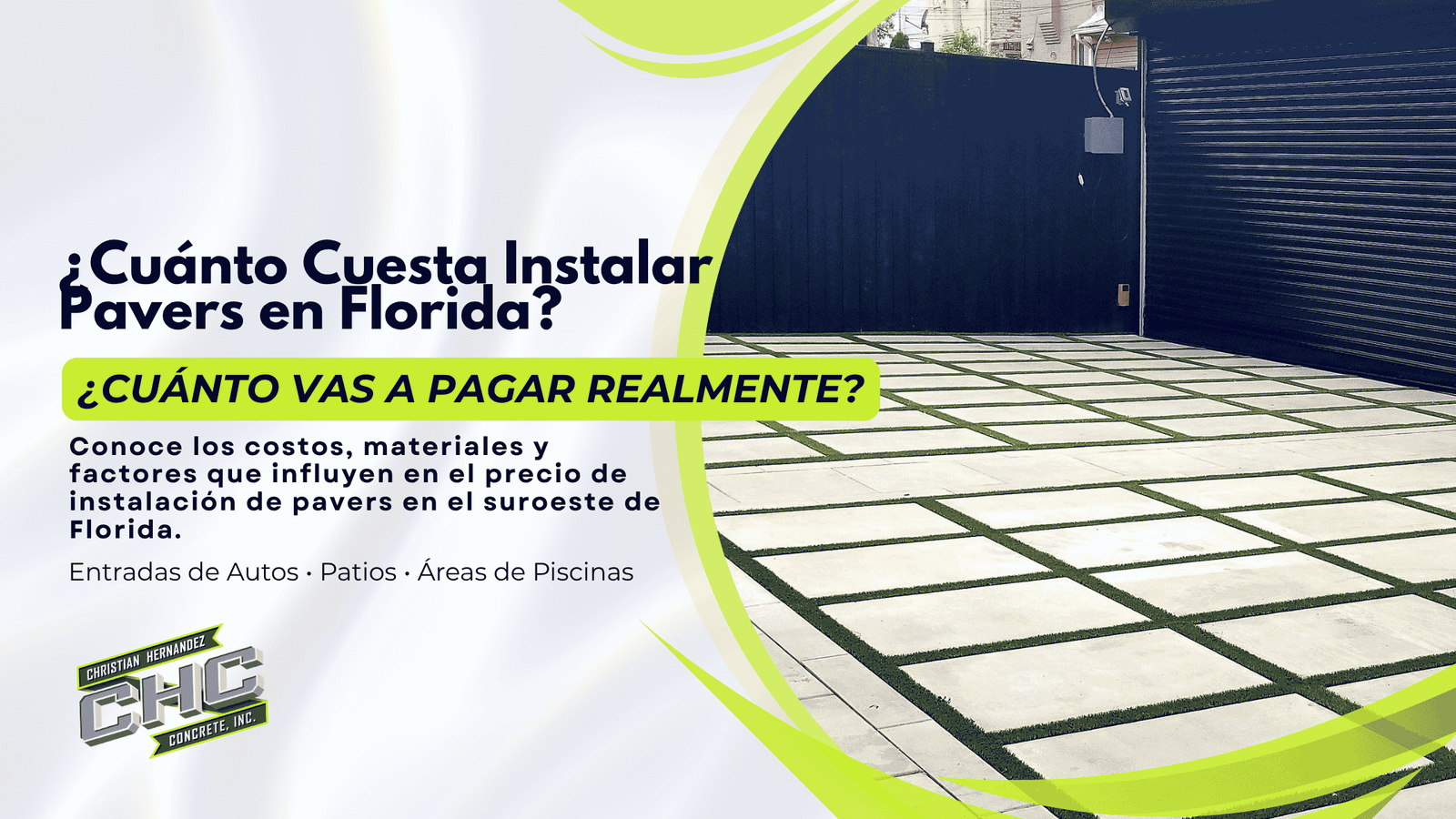
Paver driveways offer significant design flexibility. Homeowners can choose from dozens of colors, shapes, and patterns. Because pavers are individual units, damaged sections can theoretically be replaced without disturbing the entire driveway. If you’re interested in exploring paver installation for your property, it’s worth understanding both what that process involves and what the ongoing maintenance looks like in a Florida environment.
Cost Comparison: Concrete vs. Pavers in SWFL
Installation cost is often the first question homeowners ask, and the difference between concrete and pavers is substantial.
| Factor | Concrete Driveway | Paver Driveway |
|---|---|---|
| Average Installation Cost (SWFL) | $6–$10 per sq ft | $12–$22 per sq ft |
| Typical 2-Car Driveway Total | $3,000–$6,000 | $7,000–$15,000+ |
| Repair Cost (spot fix) | Moderate — patch or slab section | Low per unit, labor-intensive |
| Resealing Frequency | Every 3–5 years | Every 1–3 years |
| Lifespan (with proper installation) | 25–35 years | 20–30 years |
| Resale Value Impact | Moderate increase | Moderate-to-high increase |
Concrete delivers meaningful cost advantages at the installation stage. For homeowners managing a budget or working on a new construction project, that gap matters. Pavers can recoup some cost through perceived curb appeal, but the premium is real and upfront.
Performance in Florida Conditions
This is where the conversation gets more nuanced.
Heat and UV Exposure
Both materials absorb heat. Standard gray concrete can reach surface temperatures of 140–150°F on a sunny July afternoon. Pavers, depending on color and material, can behave similarly. Light-colored or white concrete and lighter paver options reflect more heat, which is a legitimate comfort and energy consideration for homes in SWFL.
Concrete does not degrade chemically from UV exposure. Pavers — specifically concrete pavers — can experience color fading over time under intense Florida sun. Natural stone pavers hold color better but carry a higher material cost.
Drainage and Flooding
Traditional poured concrete is impermeable. Water runs off the surface, which is manageable with proper grading but can contribute to pooling if the slope is incorrect. Permeable concrete options exist and are growing in use, though they come with higher maintenance requirements.
Pavers, by contrast, allow some water infiltration through the joints. In a region that sees intense rain events, this permeability can reduce runoff and help manage standing water. That said, the sand base beneath pavers can erode or wash away over time, particularly in areas with significant slope or repeated flooding. When the base shifts, individual pavers settle unevenly — creating tripping hazards and an uneven surface that requires resetting.
Soil Shifting and Settlement
Sandy Florida soil is not particularly stable under heavy loads. This affects both materials, but in different ways.
A concrete slab distributes load across the entire surface. If the base erodes unevenly beneath it, sections of the slab can crack. Proper subgrade preparation — compacted fill, appropriate base depth — dramatically reduces this risk. Experienced contractors like CHC Concrete account for these conditions during the prep phase, which is why installation quality matters more in Florida than in many other states.
Pavers sit on a sand-and-gravel base that is inherently more flexible. This flexibility can absorb minor ground movement, but it also means the base is susceptible to washout from heavy rain infiltrating through the joints. Over a 10–15 year period, most paver driveways in SWFL require at least one resetting to address settled or heaved sections.
Maintenance Requirements
Maintenance is where many homeowners underestimate paver driveways.
Concrete driveways in Florida require periodic sealing — typically every three to five years — to protect against staining, moisture intrusion, and surface wear. Joint repairs may be needed if control joints begin to open slightly. Beyond that, a well-installed concrete driveway is largely hands-off.
Paver driveways require more consistent attention. Joint sand washes out over time and needs to be replenished. Weeds and grass can establish in the joints if polymeric sand is not used or if the joint filler degrades. Moss and algae growth is common in shaded areas in SWFL’s humid environment. Sealing is recommended every one to two years to protect color and reduce joint erosion. Any area that settles needs to be lifted, the base releveled, and the pavers reset.
None of this is impossible work, but it adds up — both in time and in cost.
Aesthetics and Curb Appeal
This is where pavers genuinely win on paper. The design range is wide. Herringbone patterns, basket weave, fan layouts, mixed-color blends — the visual options are far more varied than standard concrete. For homeowners prioritizing curb appeal and willing to invest the premium, pavers can produce a striking finished look.
That said, concrete has evolved significantly in terms of aesthetics. Stamped concrete, exposed aggregate finishes, broom textures, and integral color options now give homeowners a broad range of looks without the cost of pavers. A professionally installed stamped concrete driveway can closely mimic the appearance of natural stone or brick while maintaining the structural advantages of a solid slab.
For homeowners in higher-end SWFL neighborhoods — areas in Naples or Bonita Springs where curb appeal carries real resale weight — pavers may justify their cost premium. For the majority of residential applications in Fort Myers, Cape Coral, and Estero, concrete delivers a clean, professional finish at a fraction of the investment.
Repair: Which Is Actually Easier?
Pavers are often marketed with the claim that damaged sections can simply be replaced. This is technically true. If a single paver cracks or discolors, it can be swapped out — provided matching replacements are available. Manufacturer color batches change over time, so an exact match after several years is not guaranteed.
Concrete repair involves patching cracks, resurfacing sections, or in more serious cases, cutting out and replacing a panel. These repairs are visible and not invisible the way a paver swap theoretically is. However, most concrete damage in SWFL, when it occurs, is surface-level and manageable. Deep structural cracking typically results from base failure — a problem that also causes paver driveways to settle.
The honest answer is that both materials require professional repair work at some point. Concrete repairs, properly executed, can extend a slab’s life for another decade or more.
Which Option Is Right for Your SWFL Home?
There is no single right answer, but there is a likely one for most homeowners in this region.
Choose concrete if:
- Budget is a primary consideration
- You want a low-maintenance, long-lasting surface
- You are building new construction or doing a full replacement
- You prefer a clean, uniform appearance with less ongoing upkeep
Consider pavers if:
- Curb appeal and design customization are your top priorities
- You have the budget for higher installation and ongoing maintenance costs
- Your property has specific drainage requirements that benefit from permeable joints
- You are in a neighborhood or HOA where paver driveways are standard
For most Southwest Florida homeowners, concrete wins the value equation. The lower upfront cost, combined with a long service life, minimal maintenance requirements, and the flexibility that modern finishing techniques provide, makes it the practical choice for the region’s conditions.
CHC Concrete has been installing residential concrete driveways across Southwest Florida for over 35 years. With 150+ five-star Google reviews and deep familiarity with the soil conditions, weather patterns, and building requirements across Lee and Collier counties, the team brings local experience that generic national contractors simply cannot replicate.
If you are weighing a driveway project in Fort Myers, Cape Coral, Naples, Bonita Springs, or the surrounding SWFL area — whether it is new installation, repair, or replacement — the right starting point is a conversation with a contractor who actually knows the ground you are building on.
Frequently Asked Questions
How long does a concrete driveway last in Florida?
A properly installed concrete driveway in Southwest Florida can last 25–35 years. Longevity depends heavily on base preparation, concrete mix quality, joint placement, and sealing. Florida’s heat and rainfall accelerate wear on poorly installed slabs, which is why hiring an experienced local contractor matters.
Ready to move forward with a driveway project in Southwest Florida? Contact CHC Concrete for a straightforward, no-pressure quote from a team with over three decades of experience serving Fort Myers, Cape Coral, Naples, and the surrounding SWFL communities.