Key Takeaways:
- Catching pothole damage early saves money — small cracks become costly structural failures if ignored in Florida’s heat and humidity.
- Not every driveway pothole can be patched. Understanding when to repair versus replace protects your investment long-term.
- Professional concrete repair done right the first time outlasts DIY fixes by years, especially in Southwest Florida’s demanding climate.
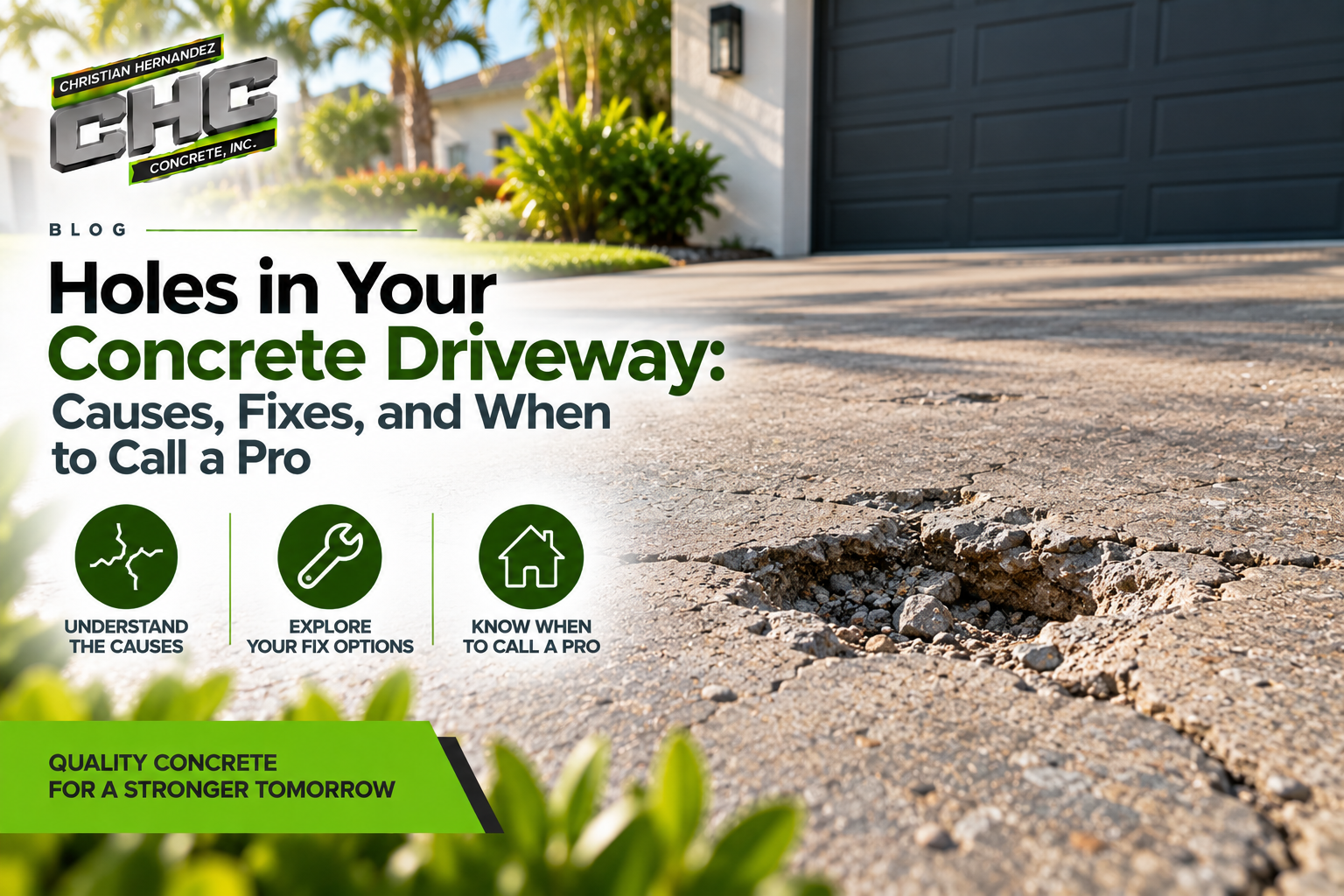
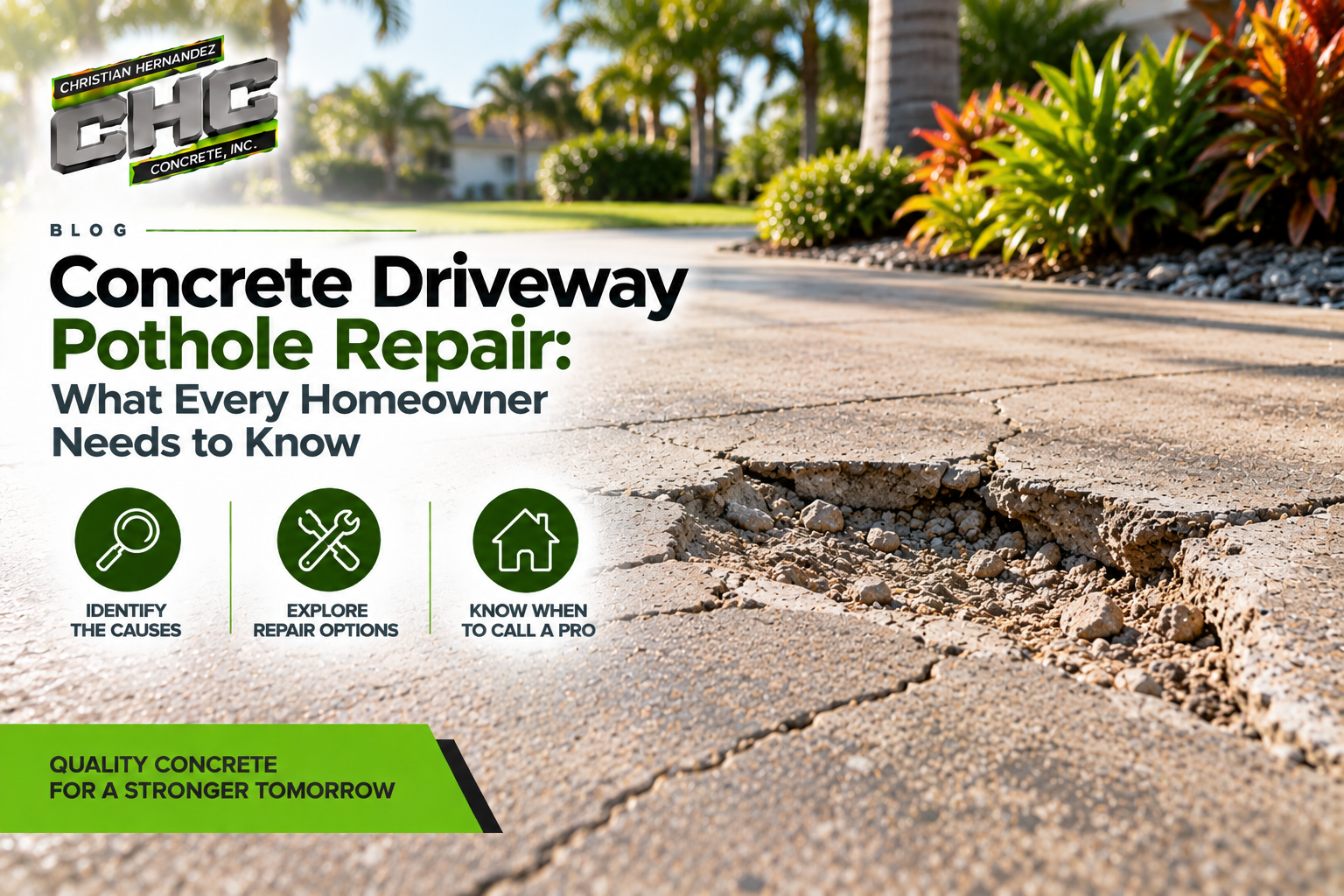
Potholes in a concrete driveway are more than an eyesore. They’re a hazard for your vehicle, a liability if someone trips, and — if left alone — a sign of deeper structural issues working their way through your slab. If you’re dealing with one right now, you’ve got questions. This guide answers them directly, from what’s actually causing the damage to what a lasting fix looks like.
Why Concrete Driveways Develop Potholes in the First Place
Concrete is tough, but it isn’t invincible. Most driveway potholes start small — a hairline crack, a spalled surface patch, or a section where the ground underneath has shifted. Over time, water infiltration, vehicle weight, and thermal movement push those small issues into full depressions or voids.
In Southwest Florida, the conditions are especially hard on concrete. The combination of intense sun, heavy rain, and high moisture content in the soil accelerates the breakdown process. Clay-heavy soils expand when saturated and contract when dry, which means the ground under your driveway is constantly in motion. That movement stresses the slab from below.
Common causes of concrete driveway potholes include:
- Subbase failure — When the compacted gravel or soil layer beneath the slab erodes or shifts, the concrete above loses support and begins to crack and sink.
- Tree root intrusion — Roots from nearby trees push upward against the underside of the slab, creating heaves and fractures that eventually hollow out.
- Heavy vehicle loads — Repeated stress from trucks, RVs, or heavy equipment exceeds what a residential slab is designed to handle.
- Poor original installation — Driveways poured without adequate thickness, proper base preparation, or control joints are far more susceptible to early failure.
- Water erosion — Standing water that seeps into cracks and works its way under the slab gradually washes out the base material, leaving a void.
Understanding the cause matters because it determines the right fix. A surface patch over a compromised subbase won’t hold. You’re essentially putting a bandage over a structural problem.
How to Assess the Damage Before You Do Anything
Before you grab a bag of concrete patch mix from the hardware store, take a closer look at what you’re actually dealing with. Walk the entire driveway, not just the visible pothole. Look for adjacent cracking, areas where the slab sounds hollow when you tap it, or sections that flex slightly under your weight.
A few things to evaluate:
Depth of the void — Is it surface spalling, or has the concrete crumbled down an inch or more? Shallow damage under half an inch is one category of repair. Deeper structural voids are another.
Size of the affected area — A localized pothole the size of a dinner plate is very different from a three-foot section where the concrete has fractured across multiple planes.
Crack patterns nearby — Spider cracking radiating outward from the pothole often signals slab movement or subbase issues beneath the surface. Linear cracks following the same direction can indicate shrinkage or a missing control joint.
Settlement — Is one edge of the pothole higher than the other? Differential settlement, where one portion of the slab has sunk while the adjacent section remains level, is a structural concern that simple patching won’t resolve.
If the area around the pothole sounds hollow, shows significant settlement, or covers more than a few square feet, you’re past DIY territory. That’s when you need a concrete repair professional who can assess the subbase condition and recommend the right scope of work.
Concrete Driveway Pothole Repair: The Right Way to Do It
Whether you’re attempting a temporary fix or working with a contractor, the process matters as much as the materials. Here’s how a proper repair should unfold.
Step 1: Clean and Prepare the Damaged Area
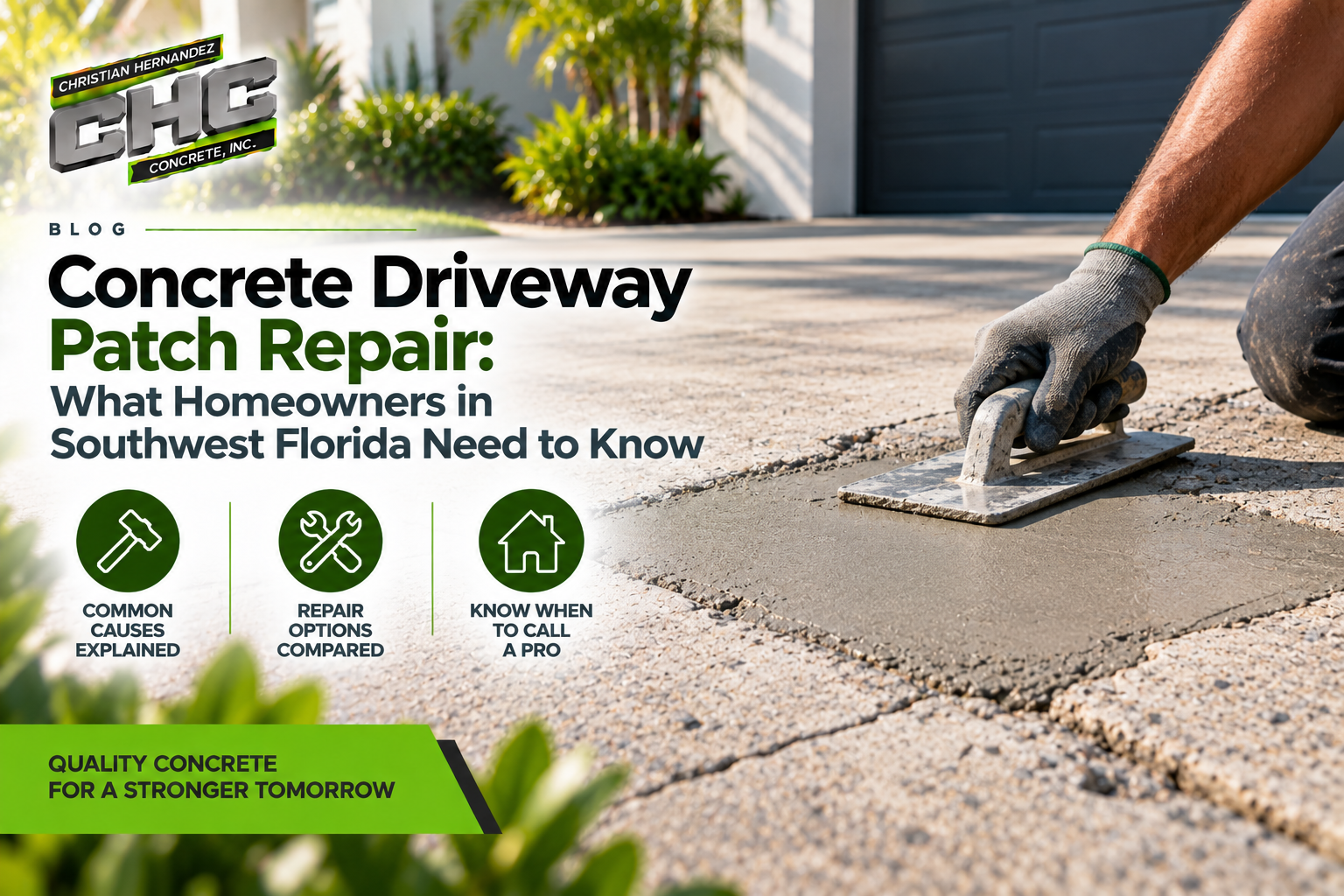
Any loose material, dirt, debris, or crumbling concrete needs to come out completely before anything goes in. Use a chisel or angle grinder to square off the edges of the pothole — this creates a defined, stable perimeter for the patch material to bond against. Feathered edges that taper to nothing will crack away quickly.
Blow out dust and debris with compressed air, then rinse the area. Let it dry, or work with a slightly damp surface depending on the repair product specifications.
Step 2: Evaluate and Stabilize the Subbase
If the pothole has a void beneath it, filling the surface without addressing what’s underneath is a temporary measure at best. A professional will probe the subbase, compact any loose material, and may inject a foam or flowable fill product to stabilize the ground before patching.
Step 3: Apply the Correct Repair Material
Not all patching compounds are equal. For concrete driveway repair, you want a product that bonds to existing concrete, handles vehicle traffic, and resists Florida’s UV exposure and moisture. Options include:
- Portland cement-based patching mortars — Strong, durable, and bond well when properly applied with a bonding agent.
- Polymer-modified concrete mix — Offers better flexibility and adhesion than standard mixes, making it a solid choice for high-stress areas.
- Epoxy injection — Used for crack stabilization and filling voids in structural applications, not typically a surface fix.
Apply the repair material in layers if the depth exceeds an inch. Tamp firmly, ensure full contact with the sides of the void, and strike off level with the surrounding surface.
Step 4: Cure and Protect
Concrete patch mixes need time and moisture to cure properly. In hot Florida sun, that means protecting the patch from drying out too fast — a common mistake that leads to surface cracking. Cover it, mist it periodically, or use a curing compound. Keep vehicle traffic off the repair for at least 24 to 48 hours, longer for deeper patches.
Repair vs. Replacement: Knowing When Patching Isn’t Enough
This is where honest contractor advice matters most. A lot of homeowners want to save money patching, and sometimes that’s absolutely the right call. But other times, you’re throwing money at a surface that’s already past the point of no return.
Here’s a straightforward breakdown to help you think through it:
| Condition | Repair Makes Sense | Consider Replacement |
|---|---|---|
| Single isolated pothole, stable base | ✓ | |
| Surface spalling over small area | ✓ | |
| Multiple potholes across the slab | ✓ | |
| Significant cracking throughout | ✓ | |
| Settlement or differential sinking | ✓ | |
| Subbase failure confirmed | ✓ | |
| Driveway over 25 years old | Case by case | Likely ✓ |
| Previous patches failing repeatedly | ✓ |
A concrete driveway that’s been patched multiple times without lasting success is telling you something. The underlying structure has broken down, and you’re in a cycle of diminishing returns. At that point, a full replacement — done properly with the right base preparation and concrete thickness — gives you decades of reliable performance instead of a few more years of maintenance.
DIY Pothole Patching: What It Can and Can’t Do
Hardware stores sell concrete patching products, and for the right situation, they work. If you have a small, isolated pothole with a solid base beneath it and the surrounding concrete is structurally sound, a quality repair product applied correctly can hold up reasonably well.
What you need to accept going in:
- DIY patches rarely match the surrounding concrete in color or texture. Over time, the difference becomes more visible, not less.
- Without professional equipment to evaluate the subbase, you’re guessing at whether the base is stable.
- Improper preparation — not squaring edges, not cleaning thoroughly, rushing the cure — dramatically shortens the life of any patch.
- Florida’s climate is unforgiving. Thermal expansion and contraction, UV exposure, and moisture work on patch interfaces aggressively.
For a temporary fix to keep your driveway functional while you plan a more comprehensive repair or replacement, DIY patching is fine. As a long-term solution for significant damage, it usually falls short.
Florida-Specific Considerations for Concrete Driveway Repair
Southwest Florida homeowners face conditions that homeowners in northern climates don’t. There’s no freeze-thaw cycle here, which actually reduces one major cause of concrete cracking. But what you do have to contend with:
Extreme UV degradation — The sun in Fort Myers, Cape Coral, and Naples is intense. UV breaks down the surface paste of concrete over time, leading to dusting and spalling that weakens the slab surface.
Soil movement from rainfall — SWFL’s sandy and clay soils respond dramatically to the wet season. Heavy rain saturates the ground, and when it dries, the contraction can leave voids under slab edges and low spots.
Humidity and moisture infiltration — High ambient humidity and occasional standing water from heavy rain events push moisture into any crack, accelerating deterioration from the inside out.
Hurricane and storm runoff — Major rain events can wash out base material from beneath driveways, particularly near downspout discharge areas or properties with poor drainage.
When you’re hiring a contractor for concrete repair in Southwest Florida, make sure they understand these local factors. Material selection, mix design, and surface sealing decisions should all account for the regional climate — not just what works generically.
What to Expect When Hiring a Concrete Contractor for Driveway Repair
A professional concrete contractor should inspect the driveway thoroughly before quoting anything. Be cautious of anyone who quotes a price over the phone without seeing the damage. The scope of work on a concrete repair job depends entirely on what’s underneath the surface, and there’s no responsible way to price that without a site visit.
What a good contractor will do:
- Assess both the surface damage and the subbase condition
- Explain clearly whether repair or replacement is the better long-term choice
- Use commercial-grade materials and equipment, not hardware store products
- Prepare the repair area properly — including squaring edges and addressing any base issues
- Provide a warranty or at minimum a clear explanation of what to expect in terms of longevity
Ask about their experience with concrete specifically. Asphalt contractors sometimes take on concrete work, but the materials and techniques are fundamentally different. You want someone who works in concrete day in and day out.
CHC Concrete has been handling residential concrete repair and replacement across Southwest Florida for over 35 years. With more than 150 five-star Google reviews from homeowners in Fort Myers, Cape Coral, Naples, Bonita Springs, Estero, and surrounding communities, the track record speaks for itself. When you call, you get contractor-level honesty — not a sales pitch.
Maintaining Your Concrete Driveway After Repair
Once a repair is complete, a little maintenance goes a long way toward protecting the investment. Seal the driveway with a quality penetrating sealer every two to three years. Keep the surface clean of standing water, especially near joints and edges. Trim back any tree roots that are encroaching on the slab perimeter before they become a structural problem.
Address new cracks early. A hairline crack that gets sealed promptly stays a hairline crack. One that’s left to a second rainy season becomes a pothole.
Frequently Asked Questions: Concrete Driveway Pothole Repair
Can you patch a concrete driveway pothole yourself?
Yes, for small, isolated potholes with a solid base underneath, DIY patching products can work as a temporary or cosmetic fix. The key is proper surface preparation — clean edges, thorough debris removal, and adequate curing time. For deeper voids, subbase issues, or widespread damage, professional repair is the more reliable option.
How long does a concrete driveway patch last?
A professionally applied patch with proper base preparation can last five to ten years or more. DIY patches applied without full surface preparation may last one to three years before cracking at the edges. In Florida’s climate, material quality and cure time are critical to longevity.
What’s the difference between concrete patching and concrete resurfacing?
Patching targets specific damaged areas — individual potholes, cracks, or spalled spots. Resurfacing applies a thin overlay across the entire surface, addressing widespread surface deterioration without removing the existing slab. Resurfacing only works when the underlying concrete is structurally intact.
When is it time to replace rather than repair a concrete driveway?
When you’re seeing multiple potholes, widespread cracking, differential settlement across the slab, or a history of repairs that keep failing, replacement is typically the smarter long-term investment. A reputable contractor can walk the driveway with you and give you an honest assessment.
How much does concrete driveway pothole repair cost?
Costs vary based on the size and depth of the damage, whether subbase work is needed, and local labor rates. Small patch repairs might range from a few hundred dollars, while larger repairs or partial slab replacement can run significantly higher. Getting an in-person estimate from a qualified contractor gives you the most accurate number for your specific situation.
CHC Concrete serves homeowners throughout Southwest Florida including Fort Myers, Cape Coral, Naples, Bonita Springs, Estero, and North Fort Myers. Contact CHC Concrete for an honest, no-pressure assessment of your driveway repair needs.